Electrical Engineering Alum Part of Duo Behind 9-Foot-Tall Game Boy Color That Actually Works
A UC Davis alum has been featured in Popular Science and Abridged for being one half of a pair of California-based engineers who have built what they say may be the largest Game Boy Color ever.
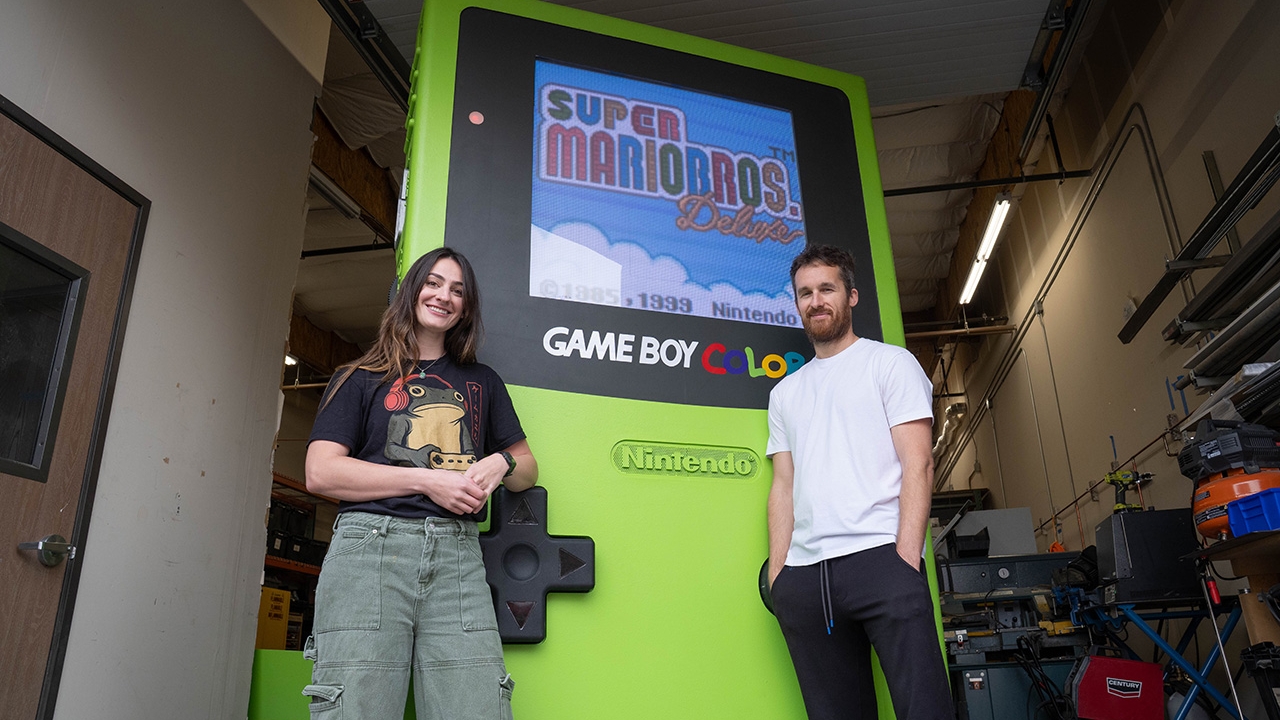
Standing more than 9 feet and weighing around 300 pounds, the Pokémon-yellow goliath requires a U-Haul to transport and took over 1,500 collective hours in a makerspace to create. And it isn’t just for show. The giant handheld plays real Game Boy games, thanks to a pixel-perfect display scaled up from the original and software written from scratch. The designers even fabricated an assortment of to-scale accessories, including game cartridges, a cable link, and AA batteries.
The giant Game Boy is the joint effort of Paige Powell, a veteran prop designer and mechanical engineer, and Nick Alvarez, who earned his Bachelor of Science and Master of Science degrees in electrical engineering from UC Davis in 2018 and 2021, respectively.
The two crossed paths while working at the Davis makerspace, just west of Sacramento. Alvarez was building a large LED wall (the kind used for screens at sports arenas) and wanted to hook up Nintendo controllers so it could play games. Piggybacking off of that, Powell proposed taking the idea a step further: a giant playable Game Boy.
Powell took the lead on building the physical body. Meanwhile, Alvarez was hard at work perfecting the display and electronics under the hood (or, in this case, the shell). He built the screen from a series of HUB75 LED panels, the kind commonly used in large digital signs. The trick was getting his massive DIY display to scale up accurately from the original Game Boy’s 160-by-144 pixel screen. He also used a small microcontroller (essentially a tiny computer assigned to a specific task) to map all of the device’s buttons and switches.
When the giant Game Boy plays games, it’s running them on a specialized emulator rather than the physical game cartridge that gets slotted into the device. The emulator is a piece of software that imitates a Game Boy.
The to-scale cartridges Powell and Alvarez fabricated are really more for show. That means, theoretically, their device can run any Game Boy game. Alvarez says he even built in a feature that cycles to a different game each time the power is switched on. So far, the pair have posted videos of the device playing Pokémon and Donkey Kong.
Powell and Alvarez have shown off their creations at two events so far: Open Sauce in 2026 and the Bay Area Maker Fair in Vallejo, California. Looking ahead, Powell and Alvarez hope to find their creation a new home where it can be on display and accessible to the public.
Get more game on: Read the full stories in Popular Science and Abridged
Cody Dowdell, a third-year electrical engineering undergraduate at UC Davis, also worked on the project. He recently posted about his experience using his woodworking skills to help assemble the Game Boy’s frame and his soldering knowledge to create a circuit board that connected the Raspberry Pi to the Game Boy’s physical buttons and dials.