Aggie Engineers Take it to the Net during Sacramento Kings’ Startup Competition
Engineering students from the University of California, Davis, made some serious noise during the Sacramento Kings Capitalize: Next Gen competition for startups in the Sacramento region.
The competition, now in its 11th year, was open to early-stage innovators ages 18-30 who are actively developing a startup within a 75-mile radius of Golden 1 Center, the home court to the NBA’s Sacramento Kings.
Data Pigeon and First Bite, both student startups built by Aggie engineers with help from the Student Startup Center’s PLASMA accelerator program, took second and third place, respectively.
Read on to learn more about these startups and the problems they are solving.
Data Pigeon
For drivers of electric vehicles, or EVs, a broken charger can be a big deal. No working charger may mean no way home without roadside assistance. There are community-driven apps that give drivers reliable data about the status of chargers, but Data Pigeon envisions a world where most charger problems are addressed before they lead to failure.
The AI-driven platform uses information from individual chargers, analyzing performance and use for EV charging operators. It looks at user session data, activity logs and even geographical location to capture a picture of the charger’s mechanical health.

“Before [a charger] goes down, we want to find out a way to predict how they are going to go down, and if they do go down, detect why they go down,” said Senara Millawabandara, a senior computer science student and co-founder and CEO of Data Pigeon.
The team is working to have Data Pigeon provide remote control of chargers to 24/7 problem support, including AI voice agents that can understand and answer client questions in real-time.
To realize their platform, the cross-causeway group of computer scientists — Millawabandara is joined by UC Davis students Suhani Shokeen and Atin Singh, and Sina Vaghefi of California State University, Sacramento — is working with the UC Davis Electric Vehicle Research Center.
“I think being in UC Davis is awesome, because Davis has actually led early innovations in the EV space,” Millawabandara said, thinking of the Aggie engineers who championed plug-in hybrid vehicles.
The team has also secured a pilot customer with whom they are working to build Data Pigeon’s foundational models.
By taking second place in the Sacramento Kings Capitalize competition, Data Pigeon will invest its $5,000 award back into the company.
“It’s amazing to see our work getting recognized like this,” said Suhani Shokeen, Data Pigeon’s co-founder and president. “I think it's honestly a great foundation for what we want to do in the future: continue the company, continue building models and solve this problem.”
First Bite
For critically ill children in an intensive care unit, an endotracheal tube is often their lifeline. Situated in their windpipe, it allows them to breathe when they cannot do so on their own. Keeping the tube in place, however, is a challenge.
Current practice is to affix the endotracheal tube by taping it to the infant’s cheeks following intubation, the procedure for inserting the tube. The tape lasts six hours at most, leading to frequent re-tapings throughout the day and putting strain on the child, family and caregivers.
The tape can also fail, particularly in the humid hospital environment, leading to the tube coming out of place and an emergency situation with severe health complications, such as lung collapse and cardiac arrest.
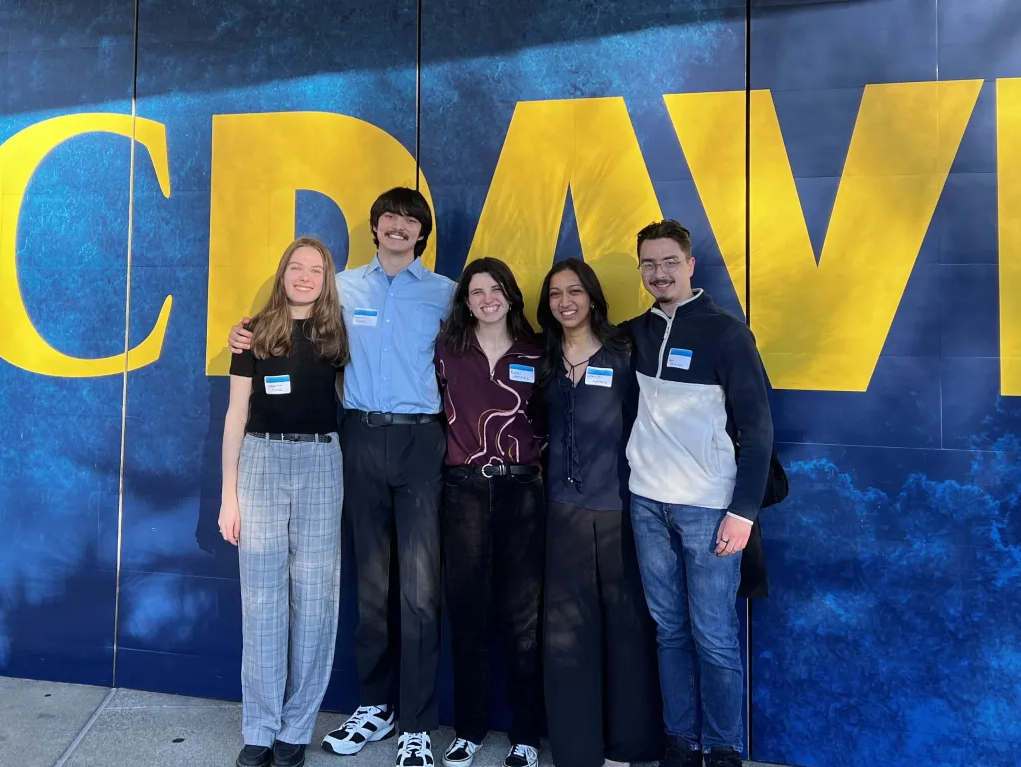
Built by a team of five biomedical engineering students as part of their senior design project, First Bite is a medical device that seeks to address these issues and advance infant care by preventing tube dislodgement while promoting patient development and long-term quality of life.
Using a head strap to non-adhesively secure the tube in place, the device positions a pacifier-like port in the infant's mouth, through which a physician or respiratory therapist can easily fix the endotracheal tube into the windpipe. First Bite can last about three to four days before the device needs to be replaced.
The pacifier design also allows the child to develop or practice their ability to swallow and suck. Traditional intubation methods prevent infants from practicing these important developmental skills.
“None of the solutions on the market currently have any component that helps the development of those natural sucking reflexes and helps the babies properly breastfeed and swallow,” said Camilla Lindh, a biomedical engineering student and co-founder of First Bite.
“As a result, a lot of times when babies are discharged from the intensive care unit, they end up not being able to do those [skills] properly and have to go to lactation consultants, basically prolonging their hospital stay and recovery.”
As third-place finishers, First Bite received a $2,500 award that the team will invest in further prototyping their design.