UC Davis Engineers Address the Hot Topic of Data Centers

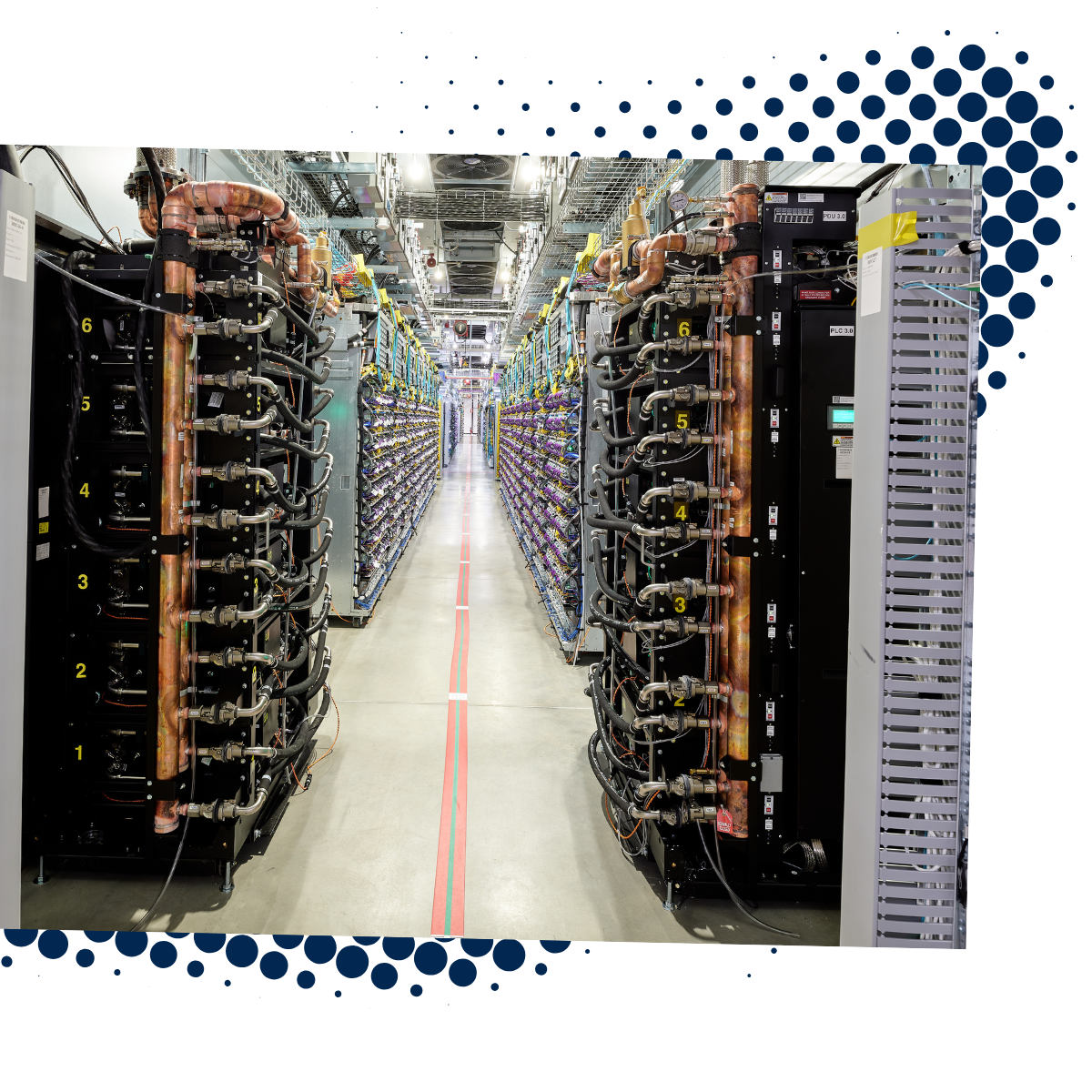
UC Davis is leading research into modular data centers, pictured, as a possible solution to the growing concern over the AI-fueled data center boom. (Courtesy of Vinod Narayanan)

by Jessica Heath | Engineering Progress Magazine 2025
Data centers are on the rise. With AI requiring more computational power, companies are scrambling to accommodate. OpenAI’s Stargate Project will invest $500 billion to build multiple data centers in several locations across the U.S. over the next few years, and Meta’s $10 billion, 2,000-acre data center in northeast Louisiana has already broken ground.
As these data centers spread, an emerging concern on everyone’s mind is the energy these buildings consume. In several states, including California, Connecticut, New York and Texas, multiple bills have been introduced to require data centers to track and report energy usage.
To answer some of the pressing questions around data centers and energy, we spoke with two University of California, Davis, experts: Professor of Mechanical and Aerospace Engineering and Faculty Director of the UC Davis Western Cooling Efficiency Center Vinod Narayanan and Assistant Professor of Computer Science Amanda Raybuck, who are putting their energy into innovating ways of making data centers more efficient and less of a burden on energy systems.

What are data centers? Why do we need them for AI?
Data centers are facilities that house servers and other equipment to store, manage and process large amounts of digital information. They range in size from small rooms, which contain a few racks of servers and can process information for a small business or a research lab, to shopping mall-size campuses, which contain tens of thousands of servers and process data for big cloud providers like Google, Microsoft and Meta.
The servers inside data centers run continuously, powering cloud services, hosting websites and apps, storing data, providing backup and disaster recovery, and supporting AI, machine learning and supercomputing tasks. In addition to the servers, data centers also house networking gear, like routers, switches and firewalls, backup power supplies and cooling systems.
Data centers are specially built to meet the needs of training and running AI models, which require a massive amount of computing power, infrastructure and storage to function. Data centers are equipped to run large-scale computations, like the ones required by the graphics processing units, or GPUs, that AI uses. The storage capacity and architecture can manage the huge datasets (text, images, video, etc.) needed to train machine models. Data centers also have systems that facilitate continuous operation, allowing apps like chatbots and voice assistants to be available and responsive at all times.
How much energy do data centers use, and what is it used for?
Data centers consume about 4% of the country’s electricity, according to the most recent data from the U.S. Department of Energy. There are two primary ways data centers use energy: the electricity required to power all the servers, and the electricity needed to cool the servers.
Consider your computer, says Narayanan. It may use 100 watts of electricity (first use) to perform a computation. Those 100 watts come out of the server as heat. To avoid overheating and malfunction, the servers need to be cooled (second use). To reduce the use of electricity for cooling, most data centers use indirect evaporative coolers, which use evaporated water to cool the air entering the data center room with the servers. It’s akin to a spray mister with a fan that someone might use to cool themselves on a hot day.
Depending on whether the system is closed or not, points out Raybuck, the water could be cooled back down and sent through the system or pushed out as wastewater, but some of the water, regardless, is going to be lost to factors like evaporation.

Are there alternative cooling methods?
In a concentrated effort to have data centers use less water, Narayanan is part of the U.S. Department of Energy’s Advanced Research Projects Agency in Energy, or ARPA-E, program COOLERCHIPS that aims to develop transformational, highly efficient and reliable cooling technologies for data centers. At UC Davis, Narayanan’s group at the Western Cooling Efficiency Center is partnering with Matt Ellis, an assistant professor of chemical engineering, the University of Michigan and several industry partners to develop a modular data center for high-compute density with a high-efficiency dry cooler.
These compact modular units, made of shipping containers, will help mitigate the need for stadium-size data centers. They will play a role in technologies such as autonomous driving, robotics and healthcare. Those high-performance computations will likely generate approximately 1.5 megawatts of heat in the footprint of a 40-foot shipping container and will need an extremely efficient cooling system. Dry cooling, Narayanan explains, takes the hot liquid and rejects the air directly by blowing cooler air over it, using less water to cool down these modular, mobile units.

What does the increasing demand for data centers mean for the power grid and for energy usage?
For the past couple of decades, the rate of energy consumption in the U.S. has remained relatively flat. Energy demand has increased but so has efficiency. With the sudden growth of data centers, that flat trajectory is starting to trend upward. Data center energy consumption is expected to reach between 6.7% and 12% in the U.S. by 2028.
Raybuck notes that there is concern that if data centers are built without consideration for sustainability, society’s reliance on fossil fuels may be extended to accommodate the strain on the grid. In Santa Clara, the heart of Silicon Valley, more than 50 data centers use about 60% of the city’s energy. With over a dozen more on the way, the state has decided to keep the Diablo Canyon nuclear power plant and other natural gas plants open to avoid blackouts.

How might green energy sources play a role?
Data center energy consumption is outpacing the rate at which utilities can bring cleaner energy sources online. They could, in worst-case scenarios, contribute to energy scarcity and drive up energy costs.
Companies and utilities are taking measures to mitigate strain on consumers, Narayanan points out. PG&E, for example, anticipates needing 10 gigawatts of electrical power by 2035 to support data center load, which is enough energy to power the entire country of Portugal. To meet that need, the organization plans to source energy from multiple different resources, including solar, wind, geothermal and hydroelectric, and develop energy storage solutions to stabilize the grid.

What should people know about data centers and their energy use?
Data centers are not just powering AI bots like ChatGPT — they provide many other useful services, such as cloud-based educational, security and health services. In October, for instance, several services, including Blackboard, Duolingo, Ring, Coursera, Smartsheet and Slack were affected by server outages at Amazon Web Services.
More and more data centers are coming online to meet the public demands for cloud-based technologies. While local, state and federal governments should work with utilities to address these needs responsibly, Raybuck posits, "Can people reduce the demand for data centers by moving some services offline?" and "How can we use these online services the most efficiently?"
To address her own questions, Raybuck examines resource efficiency and data centers, particularly in relation to computer memory, which is the third most power-hungry component in a computer, after the GPU and CPU.
One of the ways Raybuck examines smarter and more efficient ways to use memory is by running simulations on an emerging memory technology called CXL. CXL has several applications, but Raybuck is interested in how it can allow several servers to pool memory instead of each server only having its own, as well as its potential to mix and match different memory technologies to get the most use out of a system, because energy is being siphoned to systems even when the system isn’t being used. Using different memory technologies could make that energy use more efficient; for instance, an in-use server could potentially tap the energy of a server that’s not in use to make the most of available resources.

What is the big picture? Where do we go from here?
Due to the growing demand for AI services and cloud-based solutions that require enormous amounts of computing power, the data center boom shows no signs of slowing down. By the end of 2024, there were over 1,100 large data centers worldwide, having doubled over the previous five years. Reports suggest that in 2025, companies began construction on over 200 data centers in the U.S. alone.
Left unchecked, the scale at which these data centers are coming online could result in increased energy needs, leading to other implications, like an extended reliance on fossil fuels for energy, strain on the grid and rise in energy costs.
As Narayanan and Raybuck have stated, these data centers are not being built in a vacuum. Government entities and utility organizations are taking notice and making efforts to mitigate the potential repercussions of the rapidity with which the data centers are going up.
Of course, the research conducted by scientists like Narayanan and Raybuck is a crucial factor in the relationship between energy, data centers and people. If servers can share data and memory, they can use energy more efficiently. If modular data centers with high-compute density and high-efficiency cooling technology become a viable option, fewer football-field-sized data centers will be needed. These are solutions that place less strain on energy grids and give people more (literal) power.

This article was featured in our digital edition of Engineering Progress Magazine.
Read more stories.