Vertical Vision: How UC Davis is Shaping the Air Taxi Revolution
The notion of flying cars might conjure images of domed UFO-like vehicles from The Jetsons or Doc Brown’s gravity-defying DeLorean from Back to the Future.

While that depiction of futuristic travel may still be, well, futuristic, Seongkyu Lee, a professor of mechanical and aerospace engineering at the University of California, Davis, believes that urban air mobility, or UAM — the use of electric vertical takeoff and landing aircraft, or eVTOLs, in urban and suburban areas — is not too far off.
“I think people could start using this type of air taxi in the next couple of years,” he said.
As eVTOL technology gets closer to its public debut, researchers like Lee, whose focus is aeroacoustics, or how sound is generated by the movement of air, are doing the behind-the-scenes work of getting these vehicles of the future ready for the people of today. In his research, Lee investigates ways to reduce the noise and increase the performance of eVTOLs to make them easier on the ears of the pilots, passengers and passersby.
The Sound of Progress
EVTOLs have several qualities that could make them very popular: They are battery-powered, so there are no greenhouse gas emissions; they take off and land like a helicopter, but cruise like a plane, so they are ideal for urban centers; and they are much quieter than helicopters because they use multiple small rotors instead of one large one.
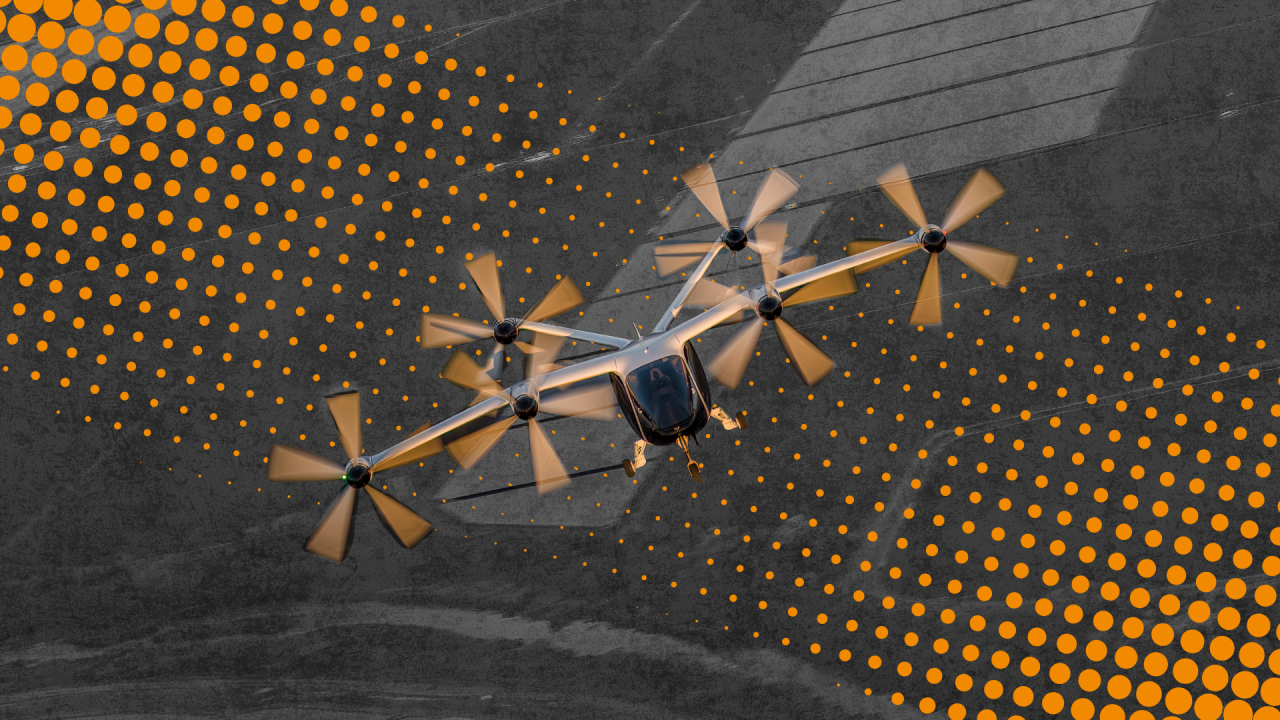
Quieter than a helicopter, though, says Lee, does not mean silence. Joby Aviation, led by UC Davis alum JoeBen Bevirt, had NASA profile its S4 prototype at its Mobile Acoustics Facility in 2022. The results showed that when the S4 flew overhead at approximately 115 miles per hour at an altitude of 500 meters, the noise level was around 45.2 decibels, which is described as somewhere between the noise of a refrigerator running and moderate rainfall. During takeoff and landing, as the S4 rose from 44 meters to 100 meters over the vertipad, noise levels stayed below 65 decibels. That’s roughly equivalent to the noise levels between normal conversation and a vacuum cleaner running.
An average helicopter, meanwhile, produces around 87 decibels at an altitude of 150 meters and approximately 78 decibels at 300 meters. And while eVTOLs are much quieter than helicopters, they still produce some noise, particularly when you add the din of the city.


Lee’s primary research objective is to continue reducing noise without reducing performance.
“The public will be willing to accept eVTOLs much more easily than helicopters because they are so much quieter,” he said. “But we also need to balance the performance. We want efficient and quiet vehicles.”
Noise reduction isn’t only about public perception. Reducing UAM noise can lead to fewer health problems associated with chronic noise exposure, like sleep disruption and cardiovascular issues. Quieter aircraft are more likely to meet noise regulations and operate longer hours (earlier in the morning and later at night). They also invite better infrastructure — less noise means vertiports can be placed closer to dense areas and won’t need any buffer zones or sound shielding.
One way Lee and his lab are doing this is by predicting and analyzing aerodynamic and aeroacoustic performance.
Lee uses high-fidelity computational fluid dynamics to predict and investigate the noise sources of UAM vehicles, specifically focusing on mid- and high-frequency tonal noise — high-pitched sound waves that measure above 2,000 Hertz, like a telephone dial tone or a dog’s sharp bark — and high-frequency broadband noise, a signal or sound that is widely distributed across many frequencies.
For broadband noise prediction, his lab also developed a software package called UCD-QuietFly, which is now widely used by eVTOL companies. His UAM research has been sponsored by NASA through the University Leadership Initiative, the U.S. Army, Hyundai, Supernal and the National Research Foundation of Korea.
In another project, supported by the college’s Next Level Research initiative, Lee and fellow collaborators, Assistant Professors of Mechanical and Aerospace Engineering Camli Badrya and Christina Harvey and Associate Professor of Civil and Environmental Engineering Holly Oldroyd, have investigated ways to redesign the propeller and wing positions for optimal performance and less noise.
“It’s not a completely new concept, but it’s not a commercially utilized concept,” Lee said. “It’s changing the propeller position over the wing, with the wing acting as a shield or barrier for the noise, to see how that enhances vehicle performance. We have already seen some improvement in aircraft performance.”
Redefining Vertical Flight at UC Davis
In addition to his own research, Lee has led the charge at UC Davis to build momentum around vertical flight. He and Badrya are participating in the Vertical Lift Research Center of Excellence at Penn State University, a consortium of universities dedicated to advancing vertical flight research and technology.

Locally, he has championed the UC Davis chapter of the Vertical Flight Society, which launched in the fall of 2024, uniting graduate and undergraduate students to compete in vertical flight competitions, participate in industry tours and collaborate on research to gain a foothold in the evolving field.
Lee is also at the forefront of developing a new online Master of Engineering degree in aerospace engineering with an emphasis on advanced air mobility. The program will include courses such as aerodynamics, aeroacoustics, numerical analysis, electric propulsion systems, aircraft design, autonomous navigation and advanced manufacturing — areas key for preparing students to build and maintain a nationwide fleet of air taxis. He aims to start the program as early as 2027.
Additionally, Lee has created a summer program focused on aerodynamics and aeroacoustics for high schoolers and teaches short online courses for the American Institute of Aeronautics and Astronautics community.
Eyes on the Skies
These efforts are part of a cohesive plan to enhance UC Davis’ position as a leader in the vertical flight space, which is quickly evolving.

Joby announced earlier this year that its electric air taxis are on track to charter their first passengers between downtown Dubai and the Dubai International Airport in 2026, cutting transit down to a fraction of the time it would take using a traditional car in the busy city center.
Companies like Archer Aviation and Boeing’s Wisk Aero are not far behind. Next year, Archer anticipates rolling out similar offerings to Joby in Abu Dhabi and aims to initiate trials with the Federal Aviation Administration, advancing toward the launch of shuttle services between Chicago and Ohio. Wisk is actively working with U.S. cities, including Miami, Houston and Los Angeles, to create the necessary infrastructure for launching their autonomous aviation vehicles.
As the notion of the first commercial flying taxi taking to the sky becomes increasingly a reality right around the corner (or puffy cloud), UC Davis will be at the forefront of bringing that vision to fruition. Lee views it as the crowning moment of his research endeavors.
“I, my students and my colleagues are making small, but important contributions, and to see the eventual product of our research, the physical vehicle flying in the sky, that would mean a lot to me,” he said. “I look forward to seeing it in the future.”