



Three UC Davis Student Teams Earn Sandia Engineering Design Awards
Three teams of senior engineering students at the University of California, Davis, presented their capstone projects to judges from Sandia National Laboratories at the 2026 Engineering Design Showcase to earn a Sandia Engineering Design Award.
The award celebrates outstanding projects that support Sandia National Laboratories' national security mission or one of the National Academy of Engineering's 14 Grand Challenges of Engineering, which range from enhancing virtual reality to advancing personalized learning. The three final projects were selected from over 40 that applied.
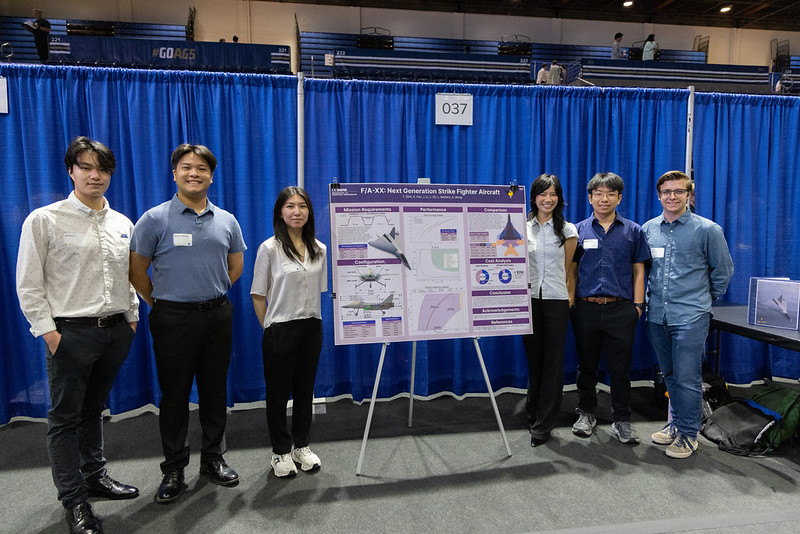
For the top prize, the judges selected the design of a next-generation strike fighter aircraft by a team from the Department of Mechanical and Aerospace Engineering.
The first-place team, comprising students Theresa Dinh, Kevin Fan, Jonas Li, Jaden Oh, Logan Redfern and Sean Wong, developed the F/A-XX carrier-capable fighter aircraft as a response to the 2026 American Institute of Aeronautics and Astronautics, or AIAA, Undergraduate Aircraft Design Request for Proposal, or RFP.
The RFP asked undergraduates to conceptualize a replacement for the Boeing F/A-18E/F Super Hornet that must reduce operational costs over the aircraft’s lifetime and improve on several of its qualities, including combat performance.
The team’s proposal focused on boosting efficiency, payload capacity and operating costs while meeting the Navy's performance requirements.
Their concept featured a blended wing body, in which the fuselage transitions smoothly into the wing. The wing and fuselage act together as a single lifting surface. This allows for a high lift-to-drag ratio and a greater internal payload capacity, both of which are ideal for a fighter jet.
They also used an existing engine with enough thrust that the plane would need only one, reducing the aircraft’s weight and overall size and increasing fuel efficiency. Using an existing engine also reduces maintenance and logistical costs.

The two additional finalist teams were also recognized with awards. One team of chemical engineering students presented their conceptual design and economic evaluation of a power-to-gas system that uses wind-generated electricity and captured carbon dioxide to produce compressed natural gas. Another team of biomedical engineering students introduced CLOVA, a reloadable implant-and-autoinjector system designed to provide long-term delivery of epilepsy medication and reduce the need for daily pills.
“Seeing undergraduates produce such rigorous, professional-grade work is incredibly impressive,” said Hemant Choudhary, one of the Sandia judges who weighed in on this year’s projects. “Their technical brilliance and teamwork give us immense hope for the future of engineering. These are exactly the innovative minds we want working alongside us at Sandia.”


