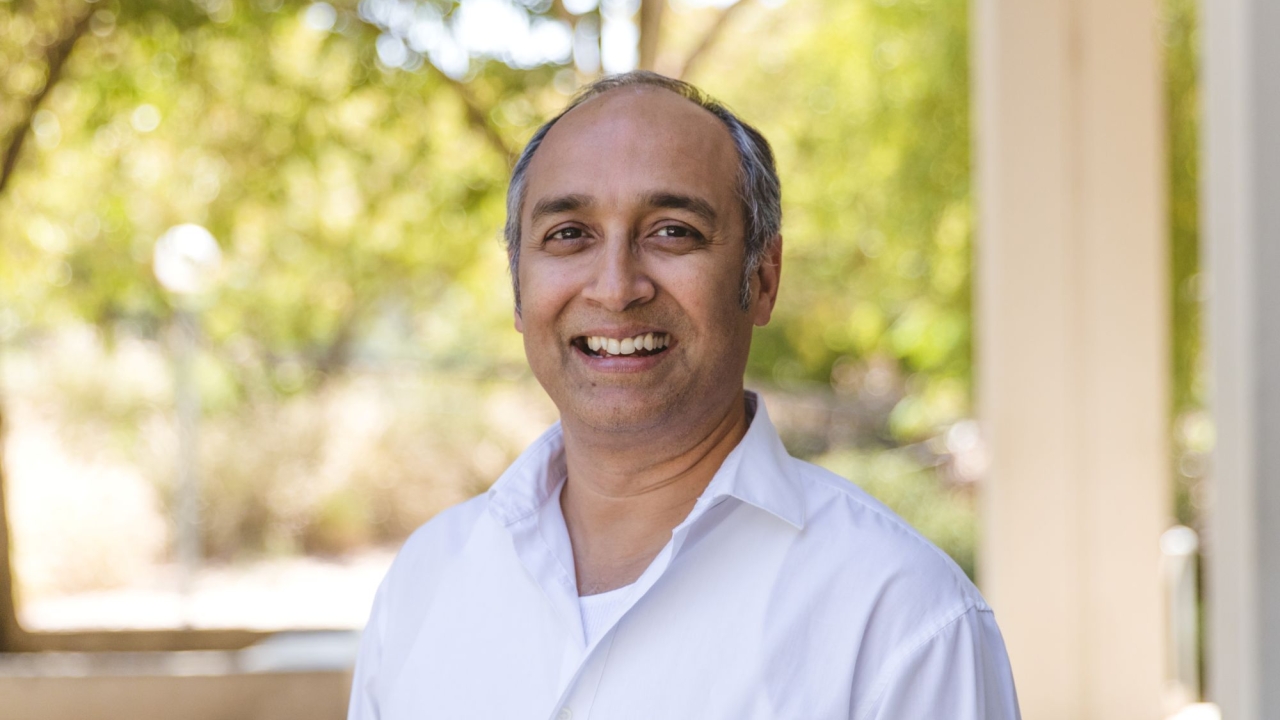
Computer Scientist’s New Book Explores Philosophy, Ethics in the Age of AI

In a new book titled “The Problems of Consensus: An Ethical Inquiry into Democratic and Decentralized Principles,” Mohammad Sadoghi, an associate professor of computer science at the University of California, Davis, investigates the concept of consensus from moral, ethical, theological and societal perspectives grounded in computer science.
In this Q&A, Sadoghi speaks about voting as a means to create a harmonious society and where ethics fits into developing AI.
Where did the idea for this book on consensus in computer science come from?
I’ve been working on consensus in computer science for about a decade, but it really starts earlier. After my Ph.D. at the University of Toronto, I joined IBM Research and focused on transactional systems. A transaction is essentially a contract — it either goes through entirely or not at all.
After IBM, I joined Purdue University and started looking at distributed transactions and what happens when a transaction can’t be executed on a single machine. Then I came to UC Davis, and I started asking, “How do we bring security and trust into this?" Around 2016 and 2017, blockchain was picking up.
In a traditional system, like a bank ledger, one entity records transactions. In blockchain, the question is, “What if we don’t want to trust that single ledger held by that one entity? What if everybody can have their own copy of the ledger?” Now, bookkeeping is turned into a voting problem, it’s democratic, where something is considered valid if the majority writes it down in their ledger — you have multiple copies, and it’s no longer centralized by a single entity, it’s decentralized. In computation, this is a problem that has been around for a while.
So, around 2017, I was looking at this problem of consensus sort of broadly, exploring “What are the things you could do to make it more efficient, more scalable, more sustainable?” Around the same time, I started building a blockchain platform called ResilientDB. When we started, we could do a few hundred transactions per second across a dozen machines. Now, we’ve scaled to millions of transactions across hundreds of machines globally.
For this book, I really wanted to focus on consensus as agreement. And the questions are, "Well, we say blockchain is democratic and decentralized, but what does that really mean? Can we find more ground in what consensus is, so it’s not just isolated in computer science, so we don’t make assumptions around it?”
What did those questions lead you to explore?
Obviously, democracy and consensus are not ideas that originated in computer science. So I went back to the basics, starting with Plato, Socrates and the ancient Greeks and read for several years. I wanted to understand how thinkers, philosophers and religious traditions have approached the idea of agreement.
In 2023, I wrote a short piece called “Meditation on Being” reflecting on the poem by Sufi Master Professor Sadegh Angha in “Chanteh — The Gnostic’s Cosmos” (page 132):
“I am, and in the infinite, I am
The mirror of divine manifestation, I am”

That meditation became the guiding thread of the book. Around it emerged a conjecture: “To vote is Be.” [In philosophy, a capitalized “Be” refers to the mode of existence rather than “being,” which is a property living entities have.]
Voting is not just about selecting an outcome. The word “vote” comes from the Latin votum, meaning vow or promise. To vote is to express something about who you are. But that raises deeper questions: Who is voting? Is it my conditioned desires, my affiliations? Or something more fundamental?
To truly vote — to truly choose — requires self-knowledge. So “to vote is Be” becomes both an epistemological and ontological question. It’s about knowing and being.
In society, we go, we vote and we fight. Perhaps the reason we vote is not so much that our side is better than the other; it is that we want to create harmony within society. In that agreement, I learn your point of view, and you learn mine. Democracy is a means of fostering understanding and harmony in society.
Why bring philosophy, ethics and computer science together?
What we’re seeing in computer science, especially when it comes to AI, is the question, “What does it mean to learn, to develop new knowledge and to discover?” In computer science, we may go into our own silos, and we might use terms that have a lot more significance and theory behind them, but many tend to ignore them. Technologies are developed that don’t have ethical values or moral principles. They are disconnected from the extensive amounts of literature and work done in other fields.
How do we broaden that perspective so that we don’t go into the super-narrow slice of our field? As important as it is, it’s a smaller vision and you will miss things.
How has this work influenced your teaching and research?
There are some interesting technical questions that arise, and the most important one goes back to the question of ethics. The word “ethics” originates from the Greek ethos, meaning character. How do we develop ethical AI? Where do we find that ethics? Is it in the code? Is it in the execution of code? Is it in the person who writes the code?
That’s something I’m going to pursue during my sabbatical coming up. I call it the ontological status of ethics in computing. Is ethical quality some kind of emergence, or is it an extension of creation — a kind of givenness? Do we as people emerge and become ethical, or does it stem from a source?
And then, what does that mean in computers? The computer gives us a nice tool to test some of these ideas and theories and make them a little more tangible. At the beginning of chapter three, the book transitions from the philosophical terminology into consensus in the computer world, so the book is kind of divided: half philosophy, half computer science.
What do you hope readers take away?
Reflection. Awareness.
The central theme is Being. To understand who you are requires reflection. It cannot be forced — it must come from within. Before prescribing social norms or building technologies, we should ask: Who are we prescribing or building them for?
Each individual has immense potential and insight. A society flourishes when that harmony allows individuals to unfold, like a seed that contains everything within it. When it sprouts, it says, “I am.”
That unfolding — that becoming, that freedom — is the heart of the book.