New AI for Health Initiative Connects Computer Science and Medicine
The University of California, Davis, Department of Computer Science is launching the AI for Health Initiative to coordinate the efforts of researchers at the intersection of computer science and health and advance responsible AI research and education in medicine.
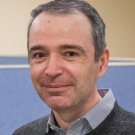
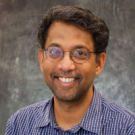
Led by Professor Vladimir Filkov, with Professor and Chair Dipak Ghosal serving as co-director, the AI for Health Initiative will connect the people, ideas and expertise needed to make artificial intelligence a powerful and responsible force in medicine.
The initiative expands a growing network of collaborations between UC Davis computer scientists, who are based in Davis, and UC Davis Health faculty and researchers, who are largely based in Sacramento across the Yolo Causeway. For Filkov and Ghosal, it is an opportunity to bridge metaphorical and physical barriers to collaboration in this space.


"Our goal is to create a home for responsible AI use for health — a place where people can find one another, share what works and turn strong individual projects into something larger," Filkov said. "Computer science is the starting point, but the real opportunity is in building deep partnerships with physicians and researchers at UC Davis Health."
Filkov has been building such partnerships through his AI for Health Lab. Over time, he saw faculty across the department tackling similar challenges, drawing on shared expertise and sometimes mentoring the same students, but without a formal structure to connect and amplify their work.
Filkov approached Ghosal with the idea of centralizing these efforts. Ghosal immediately recognized the potential to provide the rapidly growing field with a platform for broader campus impact.
“[The intersection of] AI and health is a really fertile area, and we have a lot of faculty working in this multidisciplinary field,” Ghosal said. “[I realized] we can actually have something very concrete and tangible within the department.”
The initiative’s early focus areas include multimodal AI for health, synthetic health data and digital twins — technologies that could help researchers understand complex diseases, improve clinical workflows and develop tools that are both useful and trustworthy.
It will also develop educational opportunities and programs, including talks, workshops and project-matching efforts, to support master’s and Ph.D. students in computer science and medical students interested in computational research.
For Filkov and Ghosal, housing the AI for Health Initiative within the Department of Computer Science was a clear opportunity for innovation. The department is already home to several other faculty members working at the intersection of AI and health, including Professor Sam King, Professor Ian Davidson, Professor Xin Liu, Professor Kwan-Liu Ma and Assistant Professor Lifu Huang.
Additionally, with over 15 courses focused on AI and machine learning, the Department of Computer Science teaches students the foundations needed to build powerful, explainable and reliable AI systems.
With AI becoming more accessible and influential, particularly in clinical settings, having experts who can explain why an AI model generates a particular outcome or behaves in a certain way is increasingly important.
Filkov points to the example of medical dictation software, which some doctors use to record everything said during an appointment. At a recent conference, Filkov saw many cases in which the software hallucinated or introduced errors up to 20% of the time.
"In medicine, an AI error is not just a typo," Filkov said. "It can change the meaning of a clinical note, affect a decision or create risk for a patient. To make these systems safe, we need to understand not just what they do, but why they do it. That is a computer science problem, and it is also a health problem."
During its first year, the AI for Health Initiative will focus on listening and connecting, bringing people together, mapping shared needs, developing resources and identifying funding opportunities. That grassroots work will lay the foundation for a larger, more sustainable effort.
Eventually, Filkov and Ghosal aim to grow the initiative beyond a departmental initiative into a campuswide entity, such as a center or institute, that strengthens UC Davis’ leadership in responsible AI for health.
"What excites me most is building something that lasts — something that serves UC Davis and improves the way we do health research," Filkov said. "If we can make it easier for brilliant people on both sides of the causeway to find one another and work together, we can create real value for the university and, ultimately, for patients."
Ghosal, who also serves as co-director of the UC Davis AI Center in Engineering, is enthusiastic about the growth of faculty-led efforts to advance AI.
“UC Davis engineers have created a firm foundation in AI research and are leveraging their connections across disciplines to incorporate AI into more fields of study, including health,” Ghosal said. “Their work reveals what is possible with AI. I am eager to see these collaborations continue to evolve.”
Media Resources
- Vladimir Filkov, College of Engineering, [email protected]
- Jessica Heath, College of Engineering, [email protected]