Arnab Sarkar's father studied civil engineering while working full time as a construction supervisor and it was that dedication and early exposure to the field that inspired Sarkar, Master's of Science in biological and agricultural engineering '01, Ph.D. '04 to one day study engineering and follow in his father’s footsteps.
My research aims to improve the production of energy from biological waste products, diverting waste from landfills and producing a sustainable form of energy. I use enzymes produced by fungi to break down the main component of plant biomass, cellulose, into fermentable sugars.
Artificial intelligence could be a valuable tool for the future of food safety. New research out of UC Davis finds that a technique using AI and optical imaging can quickly and accurately identify bacteria in food, making it a promising approach for preventing foodborne outbreaks and illnesses.
Tyler Barzee, M. S. '16, Ph.D. '20, is expanding the possibilities of engineering renewable food and fuel sources. Some of his recent research focuses on the development of edible gourmet mushrooms growing from recycled grains in bourbon distilleries and developing future foods from fungi.
From our morning cups of coffee to our essential health care routines, the daily aspects of our lives are being studied — and improved — by UC Davis graduate students. These scholars are committed to taking the extra step in education and discovery, all while assisting their professors and teaching undergraduates.
Post-harvest losses are common in the global food and agricultural industry. Research shows that storage grain pests can cause serious post-harvest losses, almost 9% in developed countries to 20% or more in developing countries. To address this problem, Zhongli Pan, an adjunct professor in the Department of Biological and Agricultural Engineering, has developed a potential solution.
Strawberry season may be getting streamlined thanks to new robot coworkers developed at UC Davis.
Using an innovative prediction and scheduling system, Fragile cRop hArvest-aIding mobiLe robots, or FRAIL-bots, track the picking process of each worker so when they’re finished filling a tray with strawberries, a FRAIL-bot is already nearby to take it back to the collection station for them.
Center for Information Technology Research in the Interest of Society and the Banatao Institute (CITRIS) at the University of California (UC) recently announced the 2022 CITRIS Seed Awards recipients. The eight selected proposals, submitted by multicampus teams from Berkeley, Davis, Merced and Santa Cruz, will receive up to $60,000 for their work, thanks in part to external philanthropic support.
It starts with the crunchy, crisp bites found only in the fresh leaves of iceberg lettuce. As employees in the local cafe clock in late after missing their alarm, they start their shift first counting the money in the till. That is, until their coworker comes bustling out the back doors, imploring them for help with food preparation.
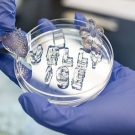
A solution to world hunger might start with boba and caviar. Using an innovative process, engineers at UC Davis are growing “myco-foods” — small balls of edible fungi that can be processed into products like boba and lab-grown caviar with a wide range of textures, colors and flavors.