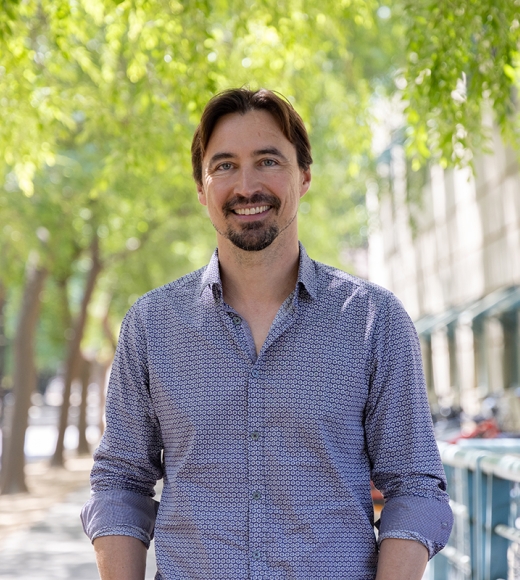
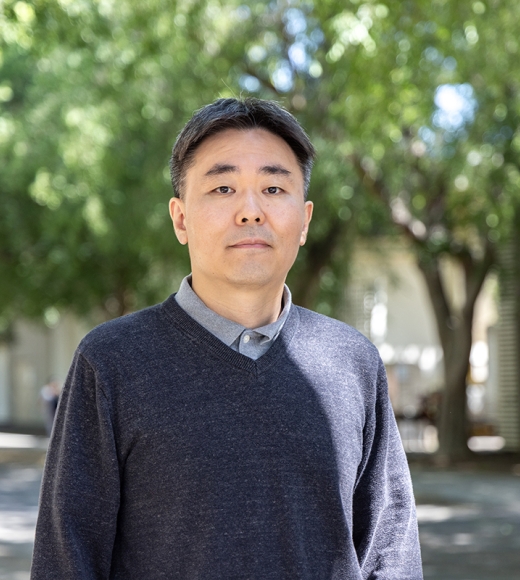
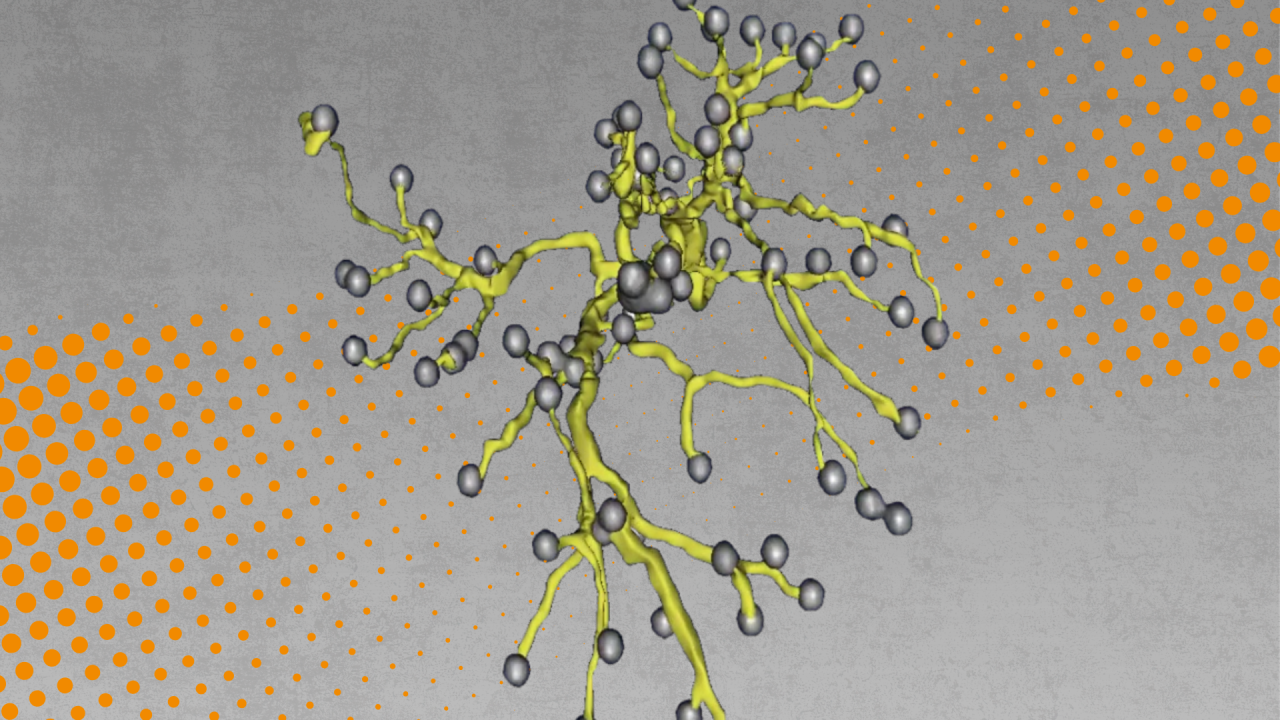
Engineers at the University of California, Davis, are helping change how we compute, communicate and power the world through advances in quantum mechanics. (Mario Rodriguez/UC Davis)

by Matt Marcure | Engineering Progress Magazine 2025
For the uninitiated, quantum mechanics are ostensibly non-physical, existing more in theory than in actuality. The classic quantum thought experiment, Schrödinger’s Cat, underscores this: How can a cat that is simultaneously alive and dead inside a box be anything more than a philosophical plaything?
A lot more. In fact, our world depends on it. Without quantum mechanics, atoms would fall apart, collapsing into nothingness. Without quantum mechanics, we would not have the modern world we have today.
Everyday technologies like solar cells, MRIs and GPS are all thanks to quantum mechanics. Transistors, too. They’re the devices capable of controlling the flow of electricity and serve as the backbone for all modern computing and communication systems, including laptops and phones.
While some may argue that we’re already in a quantum era — the field first emerged 100 years ago — science has barely begun to harness the true power of quantum technology.
Quantum computers, for example, promise to redraw the limits of possibility in science and engineering. With the capability to analyze and process data at unprecedented speeds, they will enable breakthroughs in industries such as artificial intelligence, medicine and sustainable energy that are not only impossible but also outright unknowable today.
Engineers at the University of California, Davis, are making significant strides in making that “unknowable” tomorrow a not-so-distant future. By disentangling the most pressing challenges in quantum research and bridging the gap between theory and practice, they are helping usher in the unfathomable, paradigm-shifting potential of a fully realized quantum era within the next several decades.

Scaling the Problem
Quantum physics concerns energy and matter at the subatomic scale (think: elements so small they can be dimensionless).
This means that for technology to harness quantum properties, it must operate at a size invisible to the human eye. Putting this in perspective, the microscale is as large as the field of quantum gets. And there’s an irony here: the smaller the technology becomes to enable powerful quantum properties, the larger the mechanical problems are for ensuring the device can function.
An example of this is the Casimir force, a quantum mechanical effect that draws microscopic objects toward each other so powerfully that it can cause them to tear apart. The force only intensifies the farther one scales down, presenting a fundamental limitation to the advancement of quantum technology.
Professor of Electrical and Computer Engineering Jeremy Munday and his lab have found a workaround to the Casimir force: pushing back against it.
By applying an electrical bias between two semiconductors through a p-n junction, the bias can push as the Casimir force pulls. These two opposing forces achieve an equilibrium, removing any threat of destruction to a quantum device’s minuscule mechanical pieces.
Earlier this year, his team furthered this research by showing they can control this force using specially fabricated nano-textured surfaces. With these surfaces, his team can make the force stronger, weaker or alter how its strength changes with separation.
“We have taken what was once a theoretical curiosity and showed that we now have the tools and techniques to control certain aspects of quantum interactions between surfaces, which will play an important role for future nanoscale devices,” Munday said.

Predicting Interdependent Possibilities
In addition to the Casimir force, there are many other properties that pose significant challenges to realizing quantum technology. One of the more prevalent of these is quantum entanglement.
Quantum entanglement is when two or more particles become so interdependent in a way that it is not possible to explain with classical mechanics. Although classical particles can be correlated with each other, quantum mechanics allows subtle forms of correlation between quantum particles that cannot be described by any local classical theory.
For example, while the elements remain physically separate from one another in quantum entanglement, each particle cannot be accurately described without the others. This is because the state of one particle instantly alters the state of the others, joining them into an interdependent whole. This type of quantum entanglement is known as multipartite, or many-particle, entanglement.
In a large quantum system, quantum entanglement can be much more complicated. There are innumerable ways in which these particles can be entangled. Because these correlations cannot be reproduced by any classical local model, there has been considerable difficulty in understanding the properties of these systems.
Assistant Professor of Computer Science Isaac Kim is rethinking how to study such many-particle entanglement to build new methods for understanding quantum systems. He has dubbed his research effort the “entanglement bootstrap program,” aiming to explicate the subtle structure and classification of quantum entanglement between many particles.
“Prior to the development of the entanglement bootstrap, many-particle entanglement was a subject that was deemed intractably hard, hopeless to make progress on,” Kim said of his research efforts. “Now we are realizing that there is a more tractable and recurring pattern.”
The development of technologies like high-temperature superconductors or topological quantum computers (a type of computer that incorporates built-in error resistance due to the physical properties in which information is stored) may be accelerated with the realization of a formalized method like Kim’s entanglement bootstrap — something that will enable quantum properties to be predicted like rain in a weather forecast.
In other words, there’s no way to engineer large quantum systems without advancing new techniques for understanding how the constituent particles are entangled with each other.

A Quantum Matrix
Some materials are capable of producing more quantum properties than others, such as oxides. Oxides are the combination of oxygen with a chemical element like a metal.
Seung Sae Hong, an assistant professor of materials science and engineering, is exploring oxides for their potential not only to create quantum properties but also to be the medium through which to harness them.
One of the more compelling quantum aspects of oxides is that they can enable transitions between two phases with drastically different electrical properties. For example, intercalation or deintercalation (insertion or removal) of oxygen in oxides can make the material switch between insulating and conducting states, allowing it to process digital signals.
This feature can be used like a transistor to control the flow of electrical currents in quantum devices. Transistor-based computer architecture used today separates memory and computing functions into different hardware devices, resulting in significant inefficiencies — especially for AI and machine learning processes.
Non-volatile electrical switching in oxide membranes, however, enables memory and computation to occur in the same device. This in-memory computation can lead to more energy-efficient electronics that leverage the quantum properties of materials.
“By getting a clear picture of how quantum properties are related to the structure of the material, we can design smaller, faster and more energy-efficient devices,” Hong said.
He believes that freestanding oxide membranes, or oxide membranes floating on a thin layer of water, will provide a new opportunity to observe and understand quantum properties on an atomic scale, as they can be easily studied and transferred to any other surface. These membranes will not only be a critical piece for advancing quantum technology, but, Hong says, will also fundamentally change the equation for energy consumption in electronics moving forward.
“With the emergence of AI, cryptocurrency and data centers, there’s a lot of load on the global power grid. One way to solve this problem is to harness more energy from the sun or other renewable energy sources. On the other hand, we can design devices that consume dramatically less energy to help save the Earth.”

Etching a Different Dimension
Solving obstacles in quantum mechanics and quantum-ready materials are two pieces of the puzzle. Another is figuring out how to produce quantum technology at scale.
One of the biggest challenges has been fabricating color centers in nanodevices, an essential component of quantum communication. These quantum devices use photons — discrete particles of light — to encode information, similar to modern computing’s binary language. Color centers are also where information from photons is written to and read out from the quantum memory storage.
However, unlike memory components for current computers, color centers are incredibly expensive to manufacture, creating a barrier to the widespread production of quantum technology and, therefore, the development of quantum supercomputers and an ultrafast quantum internet.
Associate Professor of Electrical and Computer Engineering Marina Radulaski and her lab have demonstrated that an angle-etching technique applied to silicon carbide, a relatively inexpensive and widely available material, can produce high-quality color centers at a fraction of the cost.
This breakthrough will enable the widespread production of quantum devices, and lay the technological foundation for quantum computers and the quantum internet.
“To make a quantum internet that coordinates quantum sensors and connects quantum computers into supercomputers, we need to make identical hardware for the many network nodes,” Radulaski said. “This is where scalable production of quantum systems enables proof-of-principle experiments to mature into deployable technology.”

Ensuring Fidelity
To achieve a meaningful quantum future, there needs to be a robust and well-rounded education that prepares the next generation of quantum experts.
Since 2019, the College of Engineering has developed six graduate and undergraduate courses in quantum information science and technology, taught by faculty members like Munday and Radulaski. Several student-led groups have also emerged, including Quantum Computing at Davis, which, among other things, has designed video games to introduce quantum concepts to students of any level.
In addition, Radulaski and Kim established the Quantum Information Science and Technology Colloquium. The annual colloquium invited scholars from around the world to engage and inspire students with cutting-edge quantum research. Starting in 2026, the colloquium will be restructured as seminars held throughout the academic year.
“Due to a number of faculty involved with quantum materials, devices and algorithms, the College of Engineering has a unique position to impact generations of students entering the workforce during the quantum computing boom,” Radulaski said. “Our trainees will define an era of discovery in new materials, medicine and security, as well as unforeseen areas of quantum impact.”
A New Zeitgeist
The first half of the 21st century is likely to be known as the age of AI, a radical and long-awaited innovation that blurs the line between science fiction and fact. Long-term, if the trajectory of researchers like Radulaski, Hong, Kim and Munday continues at this pace, it’s hard to imagine the century going down in history as anything other than the dawn of the quantum era.
That’s because quantum technology has the potential to fundamentally rewrite what’s possible, becoming a predominant and pervasive feature underpinning everything the future holds.
“The next quantum revolution is being built by engineers,” Munday said. “The types of technologies being developed at UC Davis will have the ability to help change how we compute, communicate and power the world.”

This article was featured in our digital edition of Engineering Progress Magazine.
Read more stories.