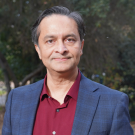
Zhi Ding Named Chair of Electrical and Computer Engineering Department
Distinguished Professor Zhi Ding has been appointed chair of the Department of Electrical and Computer Engineering at the University of California, Davis, beginning Jan. 1, 2027. He will succeed Professor Saif Islam.
A renowned expert in wireless communication, Ding has driven innovations such as cell phones and 5G technologies through his groundbreaking research.
One of Ding’s earliest contributions was shaping Multiple-Input Multiple-Output, or MIMO, systems, a communication technique in which multiple antennas are used as both transmitters and receivers to improve information capacity and transmission reliability. This work, along with his advancement of spatial multiplexing methods, has had a significant impact on the development of 4G and 5G technologies.
He has also influenced adaptive signal processing and equalization by establishing the benchmark for nonlinear decision-feedback equalizers and reduced-rank adaptive filtering. These advancements have improved performance and energy efficiency, enabling the development of modern wireless systems.
A passionate educator, Ding has worked to ensure students are prepared for an ever-changing technological landscape since he joined UC Davis in 2000. Known to generations of Aggie engineers as “Coach Ding,” he received the UC Davis Prize for Undergraduate Teaching and Scholarly Achievement last year, among the university’s highest honors for faculty excellence. He also received the College of Engineering’s Outstanding Senior Faculty Award in 2021.
He is the co-author of the textbook Modern Digital and Analog Communication Systems, which is now in its fifth edition. It is among the world’s most widely adopted undergraduate textbooks across disciplines and is used at more than 170 universities worldwide.
At UC Davis, Ding has incorporated hands-on learning opportunities into courses like “Statistical & Digital Communication” and "Signal Analysis & Communications.”
He also introduced "Digital Signals & Systems,” a course that prepares engineering students to work on AI and machine learning projects. The computer-centric curriculum uses Python, a programming language underpinning many AI technologies, to introduce students to the Discrete Fourier Transform and convolutional signal processing, bringing the college’s signal and systems curricula to the cutting edge in 2020.
Recently, Ding has turned his attention to artificial intelligence, integrating it with his theoretical insight to take wireless communication to the next level. Ding also sees AI as the new frontier of technological advancement, and he feels responsible as chair to support his department through the next wave of innovation.
“At this transformative moment when AI is revolutionizing education and society, it is a profound privilege to serve as chair,” Ding said. “I recognize the exceptionally big shoes to fill, built on decades of extraordinary leadership. I step forward with strong belief and confidence in our exceptional students, world-class faculty, dedicated staff and outstanding alumni. Together, our greatest chapters are still ahead of us.”
Ding received his Ph.D. in electrical engineering from Cornell University in 1990. Before joining UC Davis, Ding served as a faculty member at Auburn University and later at the University of Iowa.
Ding is a Fellow of the Institute of Electrical and Electronics Engineers, or IEEE. He received the IEEE Communications Society’s Technical Committee on Wireless Communication Award in 2012 and the IEEE Communications Society’s Education Award in 2020.