Shining New Light on Fetal Health During Labor
In 2015, Soheil Ghiasi, a professor of electrical and computer engineering at the University of California, Davis, was with his wife in the delivery room, eagerly awaiting the arrival of his daughter. During labor, the sensor monitoring the baby’s heart rate indicated the baby might be in distress.

The doctor recommended intervening with a C-section, prompting Ghiasi to wonder how the doctor knew it was necessary and whether heart rate is the best measure of fetal health.
“Heart rate is an inaccurate proxy for what the physicians would like to know,” Ghiasi said. “The physicians would like to know if the baby is doing well, and what that means is whether the baby is receiving oxygen through the progression of labor and all of its stresses.”
For the past decade, along with collaborators and his research team, Ghiasi has been developing a noninvasive tool that could provide a more complete picture of fetal health.
Ghiasi and electrical and computer engineering Ph.D. student Randall Fowler have recently demonstrated that their technology can estimate fetal blood pH, a key indicator of physiological stress, using near-infrared light and machine learning.
The approach could eventually help clinicians distinguish normal fluctuations in fetal oxygen levels from potentially dangerous distress, allowing them to make more informed decisions about whether to intervene.
A New pHocus
When Ghiasi first approached the issue, he and his team initially focused on developing a transabdominal fetal pulse oximeter to estimate fetal blood oxygen saturation. Ghiasi and his team worked with UC Davis Health collaborators Dr. Diana Farmer, chair of the Department of Surgery, and Aijun Wang, a professor of biomedical engineering and surgery, to test their optical device in sheep. Dr. Herman Hedriana, director of maternal-fetal medicine, also connected Ghiasi’s team with pregnant human patients to wear the device during late-term appointments to collect data.

But oxygen levels naturally fluctuate during labor, and not every drop in oxygen signals distress. The researchers needed to understand when reduced oxygen becomes dangerous.
“It took us back to the drawing board,” Ghiasi said. “We asked physicians, ‘What do you measure when the baby is born to see if the baby is doing okay or not?’ They pointed to a few physiological parameters, and the blood pH was one of them.”
When oxygen levels decline, metabolic changes can lead to the accumulation of lactate and other acids, lowering blood pH. Unlike oxygen saturation, which can change rapidly, blood pH reflects the physiological effects of reduced oxygen availability over time.
Lights, Signals, Patterns
When Fowler joined the team in 2022, he set out to investigate whether optical measurements could be used to estimate fetal blood pH without drawing blood.
The team’s smartphone-sized, flexible sensor emits near-infrared light into the mother’s abdomen. Photodetectors collect diffused light, which contains information from both maternal and fetal tissue.
Signal-processing techniques isolate the fetal signal, which is much weaker than the mother's and can get drowned out by her breathing, movements and heart rate.
“If we’re at a party with lots of people and everyone’s speaking loudly and one person is speaking very quietly, can we get just that quiet person talking?” Fowler said. “Machine learning gives us a little leg up on optimizing how we’re getting that quiet signal.”
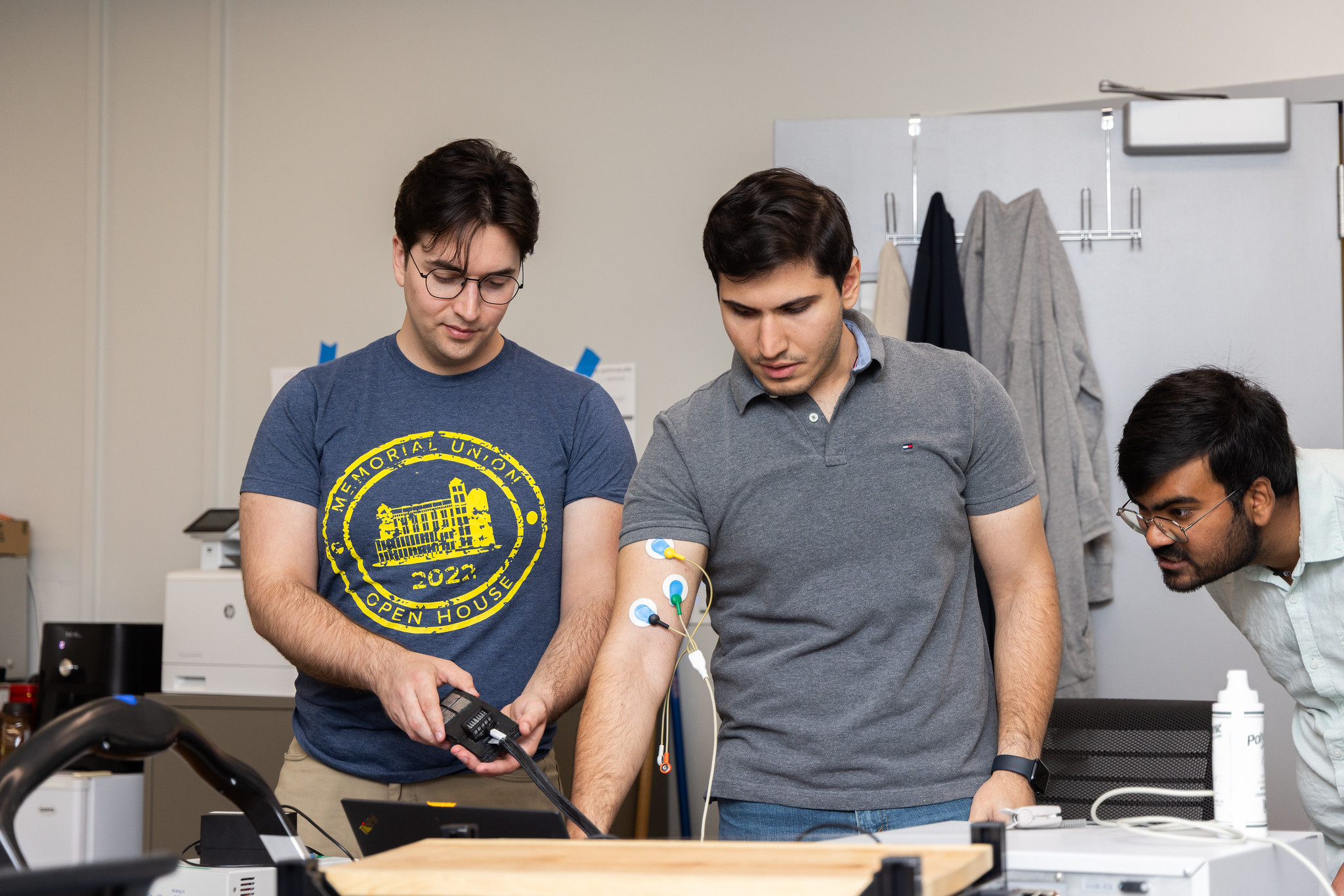
Fowler developed a machine-learning model that analyzes temporal patterns in the isolated fetal optical signal to estimate fetal blood pH.
Closer to a Noninvasive Solution
In the group’s most recent paper, published in ACM Transactions on Computing for Healthcare, the researchers analyzed optical measurements and fetal blood samples collected during controlled studies involving pregnant sheep, comparing the model’s predictions against actual fetal blood pH levels.
The group found that the approach could eventually provide clinicians with continuous information about fetal blood acidity without invasive sampling.
However, Fowler points out that to get the system into doctors' hands, they need more opportunities for testing.
“The full validity of our system is yet to be fully proven — we just don’t have enough data — but the results of this study demonstrate that it’s possible,” Fowler said.
Toward the Delivery Room
To get there, the team continues to collect optical data from human patients in partnership with Hedriana at UC Davis Health and hopes to gather additional data through animal studies with Farmer and Wang.
The researchers also aim to improve optical hardware, refine signal processing and explore whether additional wavelengths could provide more information about fetal blood chemistry. Additionally, Ghiasi is working to commercialize the device through his startup, Storx Technologies.
Ultimately, Ghiasi envisions labor and delivery rooms equipped with a noninvasive device that gives clinicians a more complete picture of fetal metabolic health, helping them recognize when a baby is experiencing hypoxic distress and, in turn, reduce the need for interventions unless absolutely necessary. A reassurance Ghiasi would have liked to have 10 years ago.
“The holy grail is inferring the fetal metabolic state, fetal heart rate and uterine contractions with one noninvasive sensor,” he said. “It’s a situation that has been demanding change for multiple decades, and something like this would help clinicians to make better decisions.”