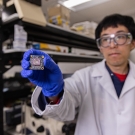
With federal funding, Assistant Professor of Biomedical Engineering Aidan Gilchrist leads a new research program to understand how the tissue surrounding a cell plays a vital role in normal and abnormal cellular metabolism states, and therefore in creating well-being or disease.
UC Davis College of Engineering ranked No. 19 among public universities in the 2026 U.S. News Best Graduate Schools rankings, with three programs in the top 10 among publics and all programs in the top 25.
A collaboration between engineering and veterinary medicine, the new Center for Animal Locomotion and Innovation at UC Davis will use cutting-edge technology to understand birds of prey in flight, advancing the design of uncrewed aerial vehicles and the treatment and rehabilitation of birds.
Dean Richard L. Corsi sits down with Chancellor Gary S. May to reflect on the imagination, principles and lifelong curiosity required to build what’s possible — and to ensure all next-level solutions of tomorrow serve the planet and the public good.
What if your next STEM teacher were an AI agent in virtual reality? UC Davis computer scientist Michael Neff combines movement science, gesture modeling and deep learning to create lifelike digital instructors — paving the way for more human embodied learning experiences.
Engineers at the University of California, Davis, have invented a device that can generate mechanical power at night by linking the natural warmth around us to the cold depths of space. The invention could be used, for example, to ventilate greenhouses or other buildings.
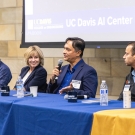
At the inaugural AI Innovation Showcase and Prem Jain Symposium, hosted by the UC Davis College of Engineering, faculty, students, alumni and industry partners explored cutting-edge research, startups and programs, emphasizing the importance of collaboration to advance AI.
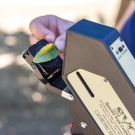
With a quick leaf scan, the AI-powered Leaf Monitor delivers real-time nutrient insights for crops. By replacing weeks-long lab tests, the new tool, developed by UC Davis engineers, can help farmers boost yields, cut fertilizer waste and manage fields with precision and sustainability.
UC Davis researchers have created a miniaturized microscope for real-time, high-resolution imaging of brain activity in mice. The device is a significant step toward revolutionizing how neuroscientists study behavior and perception in the brain.
Using total-body PET imaging to get a better understanding of long COVID disease is the goal of a new project at the University of California, Davis, in collaboration with UC San Francisco. The project is funded by a grant of $3.2 million over four years from the National Institute of Allergy and Infectious Diseases, part of the National Institutes of Health.