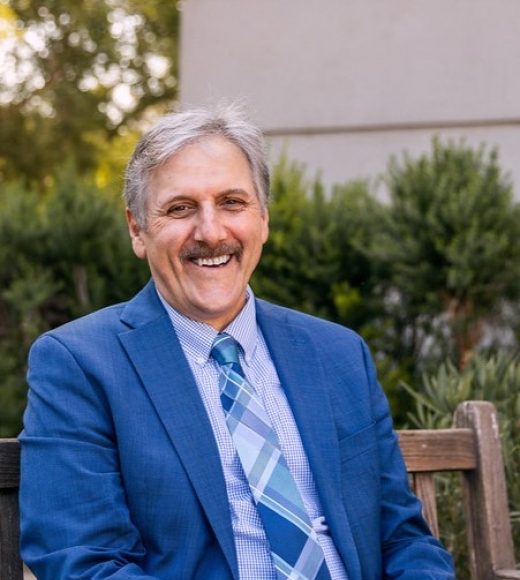
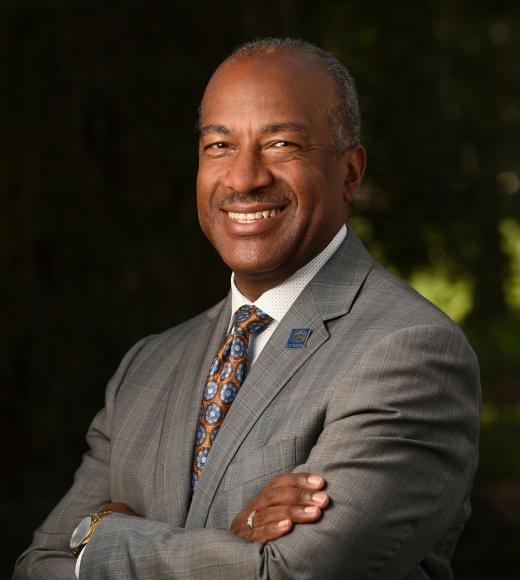
Dean Richard L. Corsi, left, poses with Chancellor Gary S. May. The two engineering leaders met to reflect on the imagination, principles and lifelong curiosity required to build what’s possible — and to ensure all next-level solutions of tomorrow serve the planet and the public good. (Mario Rodriguez/UC Davis)

by Dean Richard L. Corsi in conversation with Chancellor Gary S. May | Engineering Progress Magazine 2025
In this edition of Dean’s Download, Dean Richard L. Corsi sits down with Chancellor Gary S. May — renowned engineer, National Academy of Engineering member and longtime advocate for broadening participation in STEM — to explore what it will take to engineer a better future.
Their wide-ranging conversation explores the evolving role of engineers in society, the promise and challenges of AI, the importance of interdisciplinary collaboration and how UC Davis is shaping the next generation of innovators through project-based learning, socially responsible engineering and the growing ecosystem at Aggie Square, the university’s Sacramento-based innovation district.
Ultimately, they reflect on the imagination, principles and lifelong curiosity required to build what’s possible — and to ensure all next-level solutions serve the planet and the public good.
Richard Corsi: It's great to be here today with you, Chancellor May. Gary, to kick our conversation off, what role do you think engineers play in solving the most significant challenges and questions that face us in the future? And how may engineers adapt to ensure that their innovations towards solving those big questions, those big challenges, happen?
Gary May: You know, that's a question I get a lot. When I encourage young people to think about engineering, they always want to know, “What's the difference between a scientist and engineer?” I always say, “Well, scientists on the research side are in the business of creating new knowledge, but engineers make use of that knowledge.”
We build things, we make things, whether it be products, processes, programs, whatever it is. That's really our role, and that's what differentiates us.
So, in my mind, there can't be progress in society without engineers. Not only do we have a role in creating that progress, but we have to have a role in making sure that whatever we create is properly used. — May

May: I think the second part of your question, making the innovations happen, is a big part of it, but ensuring that the innovations are used in a way that benefits people. Now, part of that benefit is generating economic benefit, which is great, but there's also societal benefits, where you have to make sure that things are regulated well, and that they don't hurt people, they're safe, and there's ethics involved. I think engineers can't separate themselves from that piece of it as well.
Corsi: Something we talk a lot about in the College of Engineering is the importance of socially responsible engineering. We have to remember that everything we do has an impact, and we want that impact to be positive for all and not just some in society. I think that's particularly important now with artificial intelligence in our lives, right?
Speaking of AI, we do have a course called “AI for All” now, where students learn the foundational building blocks of AI. The course covers a wide range of topics, including the flaws of AI, AI concepts, paradigms, risks, benefits, ethics and applications. The ethical and societal implications of AI are really probed in that class.
We also have a graduate course called “AI and Health” that we offered for the first time this past spring, and in that class, students work in teams on real-world medical problems posed by health professionals. Applications include things like clinical note analysis with large language models, epidemic modeling, feature detection and radiological images, and also elimination of skin tone biases in skin lesion detection.
May: First of all, I'm a big fan of AI and the “AI for All” course and concept. I think a lot of people right now think AI is just for the geeks or the IT billionaires, right? But it’s actually something that's going to be in all of our lives, all aspects of our lives. AI is already in things that we buy, things that help us to get well, things that help us to get from here to there.
So, it's important to make sure that we're not afraid of it. We have to accept it. It's not going anywhere. I'm not one of these AI alarmists who think the world is in danger because of AI. We just have to be intelligent about how we use it going forward.
For example, you have to be aware of and ready to eliminate bias. You mentioned the skin tone bias. Pulse oximeters, for example, have bias. When we're trying to measure oxidation in blood, which was a very important thing to measure during the pandemic, for people like me with darker skin, the measurements were not as accurate. So, we have to make sure that these biases are not in AI as well. And there are already some issues with image detection for pedestrians with darker skin and voice recognition for women's voices. We have to make sure we can engineer things in, we can engineer things out, and we have to be really intentional about that.

Corsi: Shifting gears here a little bit, we've got this exciting new facility in Sacramento called Aggie Square, which you were instrumental in making happen. Could you say a few things about activities there, and your vision for where that goes in the future?
May: The initial vision for Aggie Square was to provide a space where UC Davis is able to bring our discoveries from the laboratory to the marketplace more efficiently, and that's still the vision, but I think it's even more timely now, because in the current environment, higher ed scholarly research has to look for multiple revenue streams to support it. The federal government is not as reliable a partner as it has always been or has been in our lifetimes. So, partnerships with industry, partnerships with entrepreneurs, are other ways to think about how we get our ideas out there, accepted and eventually commercialized. Aggie Square is going to give us a way to do that.
We started out in the life science space. Biomedical engineering has the Tech Foundry, a nearly 8,000-square-foot device development facility, and we're excited about that. We have big presence by the School of Medicine and School of Veterinary Medicine as well. But as Aggie Square continues to grow beyond phase one, we're thinking things in the sweet spot of UC Davis: ag and ag tech and ag engineering should be natural follows to what we're doing now. Food and medicine go hand in hand, right?
Corsi: Biomedical engineering is making its mark at Aggie Square with a really vibrant Quarter at Aggie Square program that offers hands-on experiences for undergraduates. They have a newly launched graduate program in medical device development, which is being taught at Aggie Square, and gives us, as the College of Engineering, the opportunity to connect our students with clinicians, providing a unique and invaluable experience for our students. Biomedical engineering is also looking at bringing in high school students in fantastic summer camps at the Tech Foundry, so they can get excited about their abilities to transform health for the world and future.
Okay, another question for you: How can UC Davis uniquely empower our students to lead in both the lab and in society? What shifts and investments, if any, are needed to engineering education as a whole, not only to adapt to the future, but to ensure current and future generations invent the future?
May: One thing I think UC Davis has an advantage culturally in is that service part of the way people think about things. It’s not just going out and starting a business and making a profit. It's, ‘How does that product, or whatever it is, serve society?’ You can think of everything from the tomato pickers to various other devices and processes that have been developed here. In my own field, electrical engineering, it's great that we have the internet and we have CGI. We can make games, movies and things that are entertaining. But we also have to get beyond that and think about how our discoveries and our scholarship and our research serve society in a broader way, and I think that's sort of right up the alley at the UC Davis College of Engineering.
Corsi: How important do you think imagination and visionary thinking are in engineering? How can we best prepare engineers to think not just about what's feasible, but what's possible?
May: I've always felt like you have to have a bit of whimsy when you're thinking about what could be possible.
One of the things that provided motivation for me is Star Trek. At one point, you see people communicating on these devices that they flip open, and then, you know, 30 years later, there's a flip phone that Motorola develops, right? You see them writing on this thing with a stylus on this funny plastic thing. But now we have iPads where we actually can do that.
I'm waiting for transporters and things like that, but you have to be able to imagine and visualize these kinds of things for them to happen. That's the really critical part for engineers, and we have to encourage that creativity in our curriculum.
Corsi: I don't think engineers will ever solve the trouble with Tribbles [a wildly invasive species in the Star Trek universe].
May: [Laughs] No. I actually hope we never have Tribbles.
Corsi: In a world that's quickly changing due to tools such as AI, how important is it to articulate the impact that engineers have, and how can engineers assume their identity as changemakers and meaningfully communicate the value of our discipline?
May: If we don't do it, nobody can, right? Engineers are developing the technology, understand it, have used it, and we have to be the ones who communicate the right way to use it to the broader audience and to eliminate some of the misgivings people have about it.
There's a lot of fear right now about new things and new technology, especially. Engineers can give a realistic assessment of what the real risks are, and we can be better positioned to have people be reassured about what is and is not possible.
Keep the Future in Focus
Join the conversation and discover what’s next for the College of Engineering and UC Davis, from campus achievements to forward-looking updates and insights that highlight next-generation ideas shaping our future. Follow Dean Corsi on Bluesky and keep up with Chancellor May on Instagram — or consider subscribing to What's Trending, the college's monthly newsletter, or Checking in With The Chancellor.
Corsi: That’s right. How important do you think project-based learning is? Working with your hands, working on teams, learning how to do stuff.
May: All of those things are critical. When I was an undergrad learning about how to do a partial differential equation, I could do it. I could follow the steps and get the answer, but I would always be wondering, "Why is this useful?" We have to be in a mode of not just teaching our students how, but why, and so project-based learning — all those things you just listed — are ways to connect the abstract and theory with something practical, and those are the students that are going to be valuable to employers and valuable as entrepreneurs.
Corsi: We got a big boost in that area a couple years ago with the opening of the Diane Bryant Engineering Student Design Center, which was named after a prominent UC Davis engineering alumna. That space provides leading-edge prototyping, manufacturing and fabrication techniques. It's an environment that creates a diverse and inclusive pipeline for engineers at all levels.
Embedded within the ESDC is our Student Startup Center, which assists students interested in all stages of the entrepreneurial process. It reaches about 2,000 students a quarter.
May: I’m a big fan of both of those facilities. I am grateful for Diane Bryant as well. She told me a few days ago, “This is the only engineering building named after a woman in the United States.”
Students have to have a place, a playground, a sandbox, to be able to explore ideas with some guidance from us, both in terms of project work, but also entrepreneurial work. I'd love to see us have 100 student startups a year or more. Now, recognizing that all those aren't going to be successful, but that's not really the goal. The goal is to teach them the entrepreneurial process.
Socially responsible entrepreneurship is an important complement to socially responsible engineering. Our students can be entrepreneurs and use entrepreneurial thinking to solve big problems in the world with innovations that help people. — Corsi

Corsi: In your opinion, what's a really significant challenge the world is currently facing, or will soon? What investments or innovations are needed for engineers to address that challenge?
May: I'm going to surprise you, because I'm not going to give a technical answer. It’s a social answer more than anything else: polarization that's been fed by misinformation. It's rampant, it's everywhere.
And where do engineers come in? Well, if we can develop trusted tools that provide accurate, reliable information that can be checked against facts, that would be so useful right now in this current environment. That's really what's pulling our society apart – the fact that people don't believe vaccines are effective, that people don't believe in climate change. That's all being exacerbated because of misinformation, and I would hope that engineers would like to play a role in developing a solution to these problems.
Corsi: Wouldn't it be nice if there were automatic and real-time fact-checking on all social media platforms?
As the world becomes increasingly complex, how can we accelerate breakthroughs at the intersection of disciplines to tackle global problems?
May: To be interdisciplinary, you first have to have a strong foundation of the disciplines. You can't do that sort of willy-nilly. You have to be able to join two or more disciplines together. They both have to be strong.
A good example here at UC Davis is the Bird Flight Research Center, where the College of Engineering and the School of Veterinary Medicine have joined forces to study how birds fly and use that knowledge to make better flying objects. You get good outcomes when you have different knowledge bases joining forces like that.
Corsi: Absolutely. That new facility is generating a lot of excitement across campus. This makes me wonder, what do you think a future-ready engineer looks like?
May: We used to teach our students to be prepared for the job they'll accept when they graduate. Now we're teaching our students to be prepared for jobs that we don't even know will exist. So, the future readiness is about being a lifelong learner who's flexible, who maintains curiosity throughout life, willing to refresh their knowledge base and be open to new possibilities.
Corsi: What innovation are you most looking forward to in the future? Being an avowed Star Trek fan, as you mentioned, I'm sure there are many Trekkie things you could name.
May: The coolest thing about Star Trek was the exploration. I think, in our hearts, humans are curious and want to explore. That's why we've populated the world, because we went out from wherever we originated and covered the surface of the Earth.
I think one of the next frontiers is what's out there beyond Earth, space travel, habitats in space or on planets. We have to be able to get there first. That's the kind of thing that, among other things, about Star Trek that really piqued my interest.
Corsi: We have an astronaut, Steve Robinson, on our faculty, and he's got this wonderful laboratory looking at these kinds of things. An early-career faculty member, Rich Whittle, is doing some really great work on bioastronautics and habitat systems in space. We are excited about their research.
May: I keep saying about these privately sponsored space trips, “If I can get a sponsor, I'm going to go.”
Corsi: You remember Captain Kirk went on one of them, right?
May: He did. [William] Shatner went on one at like age 90. I'm jealous.
Corsi: Chancellor May, I want to express my gratitude for this conversation.
I have found our discussion about the hope for the future of engineering, research, education and impact to be inspiring. Engineers will play a major role in solving the greatest challenges that face humankind and the planet. But obviously, we have to work with many others in the process.
May: Agreed. Dean Corsi, I appreciate your leadership with the college and the good direction that it is headed.

This article was featured in our digital edition of Engineering Progress Magazine.
Read more stories.