



From Ground Up to Full Throttle: Inside Davis Baja Racing

Davis Baja Racing, a student-led competitive team at the University of California, Davis, is giving new meaning to the word “driven.”
Baja racing or “baja” as it is commonly referred, is a type of off-road single-seated motorsport racing in harsh desert terrain. Meaning “lower” in Spanish, baja also symbolizes how Davis’ Baja team had to restart from the ground up. Today, after some fits and starts, the group is firing on all cylinders and revving up for their regional competition this spring.
The Team’s Ignition
Davis Baja Racing has 35 team members operating in five subteams: electrical, chassis, drivetrain, suspension and wheel dynamics. Building a car that can successfully traverse the desert terrain at the regional competition in Waushah, Washington from May 7-10 requires structure, collaboration and adaptability. In order to appreciate where they are today, one must look at their origin story.
Davis Baja Racing began in 2012 and was disbanded due to the COVID-19 pandemic. In 2024, Jack Kimble, then a first-year electrical engineering student, and two of his peers took the initiative to re-assemble the organization.
“We wanted to keep Baja alive because it provided a fairly unique experience for engineering students, " said Kimble, who mentioned how Baja is the only off-road racing team in the university, validating its uniqueness compared with other teams.

Now, as team captain, Kimble could be described as a “jack of all trades.” His commitment to the growth of the club and the team as a whole is showcased through his leadership in welding, team meetings, finances and design consultation.
In those early days, the three-person team was small yet committed to overcoming the loss of members and data during the COVID-19 pandemic. The tenacity, fortitude and character of the club during this initial phase was what drew in some key members.
Nathan Bence, a second-year managerial economics and environmental policy major, is the head of operations for Davis Baja Racing. Bence takes care of day-to-day logistics, event coordination, public relations, finances and sponsorships. He recognized this group’s resilience was emblematic of Baja Racing’s very essence.
“Baja racing is very dynamic. Rules are always changing, stuff breaks down and competitions are challenging,” said Bence. “It is a pressure test for all our engineers and mechanics, pushing us to the limit.”
Rebuilding Momentum
Last year, in their first full year of rebuilding, the small team worked to recapture its membership through promotion and demonstrating their skill by manufacturing car components from used materials.
Despite their extremely limited funding and membership, they were able to assemble a car in time for regionals in the spring of 2025. Unfortunately, their car could not pass technical inspection, disqualifying them from the race.
Returning in the fall, the team made a big push to promote the club and pursued sponsors in earnest. With the change of seasons, the team started to see their luck change as well.
As the winter ensued, despite temperatures dropping, the group’s popularity ramped up.
“In winter we got a big rush of people coming in at the beginning of the quarter after promoting the club, and we locked down sponsor deals over winter break,” said Kimble.
The Joseph Beggs Foundation is a non-profit organization that supports the pursuit of mechanical engineering students and student organizations. They have been a consistent supporter of UC Davis’s Baja Racing Team since the group’s early restoration. This foundation has contributed a large percentage of total sponsorship funds for Baja, which has been instrumental in its revitalization.
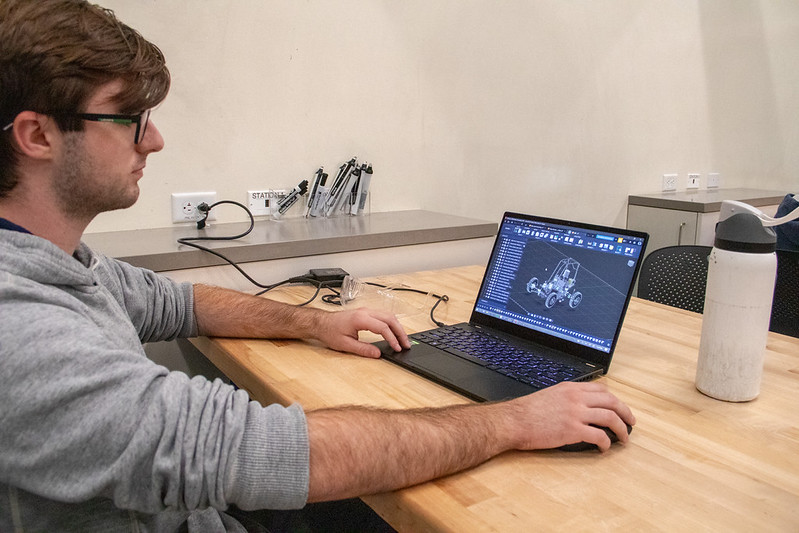
Autodesk, a software company that provides Computer Aided Design, or CAD, products and services, is a prominent sponsor. This software allows the team to create blueprints for complex engineering designs such as the chassis, the car’s skeletal structure.
These and other sponsorships compose a majority of the group’s funding, enabling them to buy higher grade equipment and enhance their budget for regional competition trip expenses.
“It gives our engineers flexibility to find creative solutions and problem-solve,” said Bence.
One of those problem solvers is Ian Carlson, a fourth-year mechanical engineering student and car enthusiast, who serves as the vice president and drivetrain subteam lead for Baja.
“I’ve been into cars since I was 3 and turned on my dad’s Firebird engine,” said Carlson.
Carlson’s role as the drivetrain subteam lead is crucial. His team designs and optimizes the car’s systems and internal components and is responsible for making sure the engine and transmission they operate meet the standards to pass technical inspection. Back in the classroom, he learns engineering principles that are applicable to his work.
“‘Mechanical Design 2’ was where we learned about gear ratios, sprockets, and how to perform bolt calculations,” said Carlson, all essential concepts to produce a functional automotive vehicle.
A Competitive Drive

Today, the Baja team and its members are back up and running in full.
According to Bence, they have at least one person working in the Diane Bryant Engineering Student Design Center every operational hour. Having this resource is a huge boon to the team members, who are putting their all into getting to the competition.
“I’m immensely proud of the team and the hard work they are doing, " said Bence. “The chemistry is there.”
That chemistry ignites the team, fueling their drive and dedication as they prepare for the upcoming regional competition. Despite not passing inspection last year, the group enters this year’s competition motivated and prepared to pass the technical inspections, qualify and compete.
Kimble’s goal? To cross the finish line in the endurance race.
“If we can compete, then we’ll already be in the top 75,” he said.
And for a team that was all but totaled until two years ago, getting to the competition is itself a huge win.


