Two M.D./Ph.D. students with a biomedical engineering focus have been awarded grants from the California Initiative to Advance Precision Medicine. The grants support leading-edge research aimed at improving patient care and advancing health equity.
Led by the UC Davis Department of Computer Science, the AI for Health Initiative will connect researchers and clinicians across disciplines to advance responsible AI use in medicine, support student training and strengthen partnerships with UC Davis Health.
Clinicians and engineers at the University of California, Davis, are collaborating on AI-driven tools to analyze vast digital archives of brain tissue scans — work that cannot be done at scale by humans alone — to better understand dementia and improve diagnosis and treatment.
The AI and Health Seed Funding Program is a new initiative focused on strengthening interdisciplinary connections between schools and colleges across UC Davis and UC Davis Health. Engineers are members of three out of six teams to receive the program’s inaugural awards.
What if a smartphone could see what the human eye misses? A new UC Davis-designed app uses machine learning to track subtle hand movements during stroke rehabilitation, giving clinicians more specific data to assess recovery and tailor patient care.
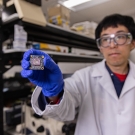
A recent study led by electrical and computer engineers at UC Davis, and reported in Advanced Photonics, has demonstrated that the power of a spectrometer can be replicated on a microscopic chip. This innovation paves the way for next-generation medical diagnostics and agricultural and environmental remote sensing.
Dean Richard L. Corsi sits down with Chancellor Gary S. May to reflect on the imagination, principles and lifelong curiosity required to build what’s possible — and to ensure all next-level solutions of tomorrow serve the planet and the public good.
UC Davis engineers Cristina Davis and Zhaodan Kong are building sensors and smart drones to spot the earliest signs of disease in wildlife. Their work with the NSF Center for Pandemic Insights could help catch outbreaks before they spread — and maybe stop them from becoming a global pandemic.
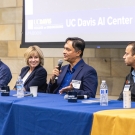
At the inaugural AI Innovation Showcase and Prem Jain Symposium, hosted by the UC Davis College of Engineering, faculty, students, alumni and industry partners explored cutting-edge research, startups and programs, emphasizing the importance of collaboration to advance AI.
UC Davis researchers have created a miniaturized microscope for real-time, high-resolution imaging of brain activity in mice. The device is a significant step toward revolutionizing how neuroscientists study behavior and perception in the brain.