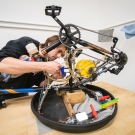
UC Davis researcher Rich Whittle joined an international team aboard a parabolic flight to study how microgravity affects blood flow to protect astronauts during long-duration space missions.
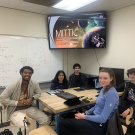
UC Davis students Aidan Guerra and Andres Mino Cortes discuss advancing to the final phase of the 2026 NASA Human Lander Challenge, the lessons they learned from NASA engineers and how the experience is shaping the future of the Aggie Space Initiative.
In this Q&A, Aggie Engineer Ava Lewis shares the ins and outs of attending a major aerospace conference as an AIAA Rising Star, from meeting aerospace influencers to landing recruiter conversations to forging connections that will last a lifetime.
A dynamic digital twin designed by researchers at UC Davis was launched into Earth’s orbit on a SpaceX Falcon 9 rocket. The payload is expected to send data about the satellite’s state of health over the next month.
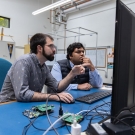
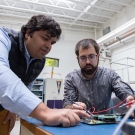
UC Davis engineering students are taking their research to orbit, building an AI-powered digital twin to track satellite battery health. The project blends teamwork, ingenuity and space-tested problem-solving, with applications reaching far beyond Earth.
Engineering researchers and Proteus Space are shaking up satellite design with the first-ever real-time dynamic digital twin in orbit. The AI-enabled payload, designed in the HRVIP Lab, will model and predict spacecraft health on the fly, redefining the future of spaceflight.
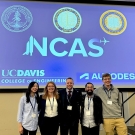
Urban air mobility, AI-driven aerospace design and what’s next in space exploration took center stage at the second annual Northern California Aerospace Symposium, which brought researchers, students and industry leaders to UC Davis to advance aerospace research and collaboration.
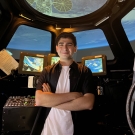
From capturing the cosmos through astrophotography to being boots on the ground as a NASA intern, aerospace and mechanical engineering undergraduate student Aidan Guerra is driven by exploring humanity's connection to space.
Robots. Laundry. Emergency care. At the University of California, Davis, Center for Spaceflight Research, these topics and more are investigated as they relate to human spaceflight. The multidisciplinary research center is poised to become the preeminent resource for human spaceflight engineering research in the U.S.
The first-ever UC Davis branch of Students for the Exploration and Development of Space kicks off its first year by submitting innovations like an inflatable emergency habitat and fuel recovery technology to NASA challenges.