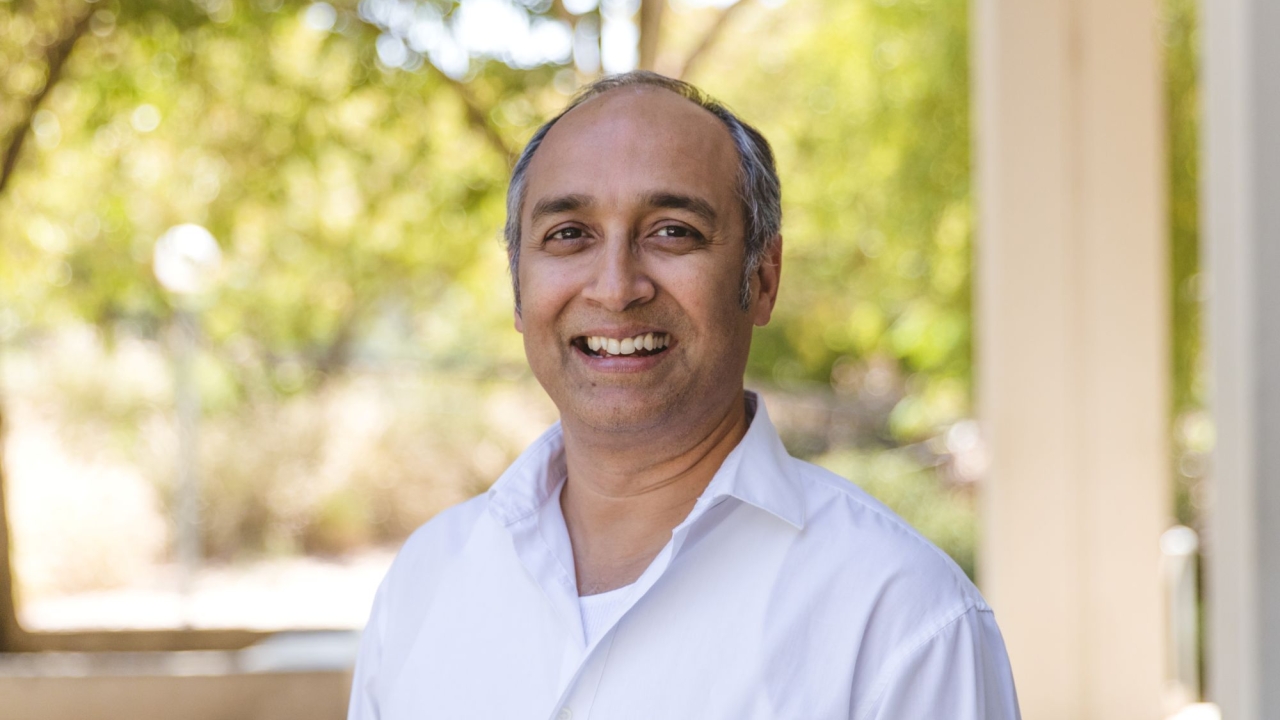
New Faculty Member Nick Pant Bridges Disciplines to Build Better Electronics
On paper, Aagnik “Nick” Pant’s academic path may not make him an obvious fit for the Department of Materials Science and Engineering at the University of California, Davis, which he joins as an assistant professor this fall.

A Bachelor of Engineering degree in electrical engineering from McGill University and a Ph.D. in applied physics and scientific computing from the University of Michigan, as well as a postdoctoral appointment at the Oden Institute for Computational Engineering and Sciences and the Department of Physics at the University of Texas at Austin, may not immediately suggest “materials science.”
However, it makes perfect sense to Pant, whose goal is to use computational science, including machine learning and quantum mechanics, to determine material properties and identify promising materials for energy-efficient electronic technologies.
“You have the materials themselves, which is what theorists, like myself, usually study, and then you have a whole other community within electrical engineering that studies devices,” Pant said. “Because I have that background in electrical engineering, materials science and physics, I want to see if I can bridge this gap and tighten that integration a little better.”
Following the Semiconductors
Pant has always had broad interests in science; in high school, he explored computer science, computer engineering and biological engineering. When it came time to think about college, he was advised to pursue electrical engineering, as it would allow him to conduct research in multiple scientific and technical fields.
At McGill, Pant was an undergraduate researcher in an electrical engineering lab that used semiconductors to enable artificial photosynthesis, capturing solar energy to convert carbon dioxide into renewable fuels. The experience set Pant on a path to learn as much as he could about semiconductors, leading him to pursue a Ph.D. in physics.
“I really wanted to dive deeply into semiconductors,” he said. “There’s a branch of physics focused on understanding materials and understanding how the electronic structure of matter gives rise to their properties.”
"I'm not a pure physicist. I'm not a pure electrical engineer. My background has been different across fields. I think UC Davis is exactly where my research would be at home."
— Nick Pant
In his dissertation, Pant studied III-nitride semiconductors, a family of materials used in technologies such as LEDs and high-power USB-C chargers, with potential applications in faster EV charging and UV sterilization. Pant used quantum-mechanical computational methods to investigate how microscopic processes involving atoms and electrons affect the performance of electronic devices.
During his three years as a postdoctoral fellow, Pant built on that work by using machine learning to identify simpler equations that could reproduce the results of complex calculations normally performed on supercomputers. By requiring far less computing power, these equations allow researchers to move beyond models of perfectly ordered materials and study the kinds of imperfections and disorder found in real materials.
A New Home for His Research
Pant will continue this work at UC Davis, exploring recent advances in machine learning and AI to make quantum-mechanical calculations more feasible and use the resulting insights to match materials with applications where they can perform most efficiently.
“What I find exciting about materials science is that you can predict everything,” Pant said. “Starting from very simple equations that describe the universe, and knowing only the atoms that we have, you can predict basically anything about any material that you want. If we can predict the properties of materials, we can predict how those materials might behave in devices and, hopefully, enable electronic technologies that benefit society.”
Coming directly from a postdoctoral fellowship, Pant looks forward to finding his balance between the teaching, research and service duties of a faculty member. He is particularly eager to connect with students.
“When someone doesn't know the field, and you introduce them to new aspects of science, you just see curiosity in their eyes, and the lights go on. Or when they're struggling to understand a concept, and it clicks, and you can really see them getting excited by it, I'm ready to nurture that. I'm looking forward to that quite a bit.”
Beyond the classroom, Pant sees UC Davis as a place where his research can thrive because of its interdisciplinary nature. Pant anticipates collaborating with colleagues in his department, as well as faculty in electrical and computer engineering, chemistry and physics, to uncover the “research synergies” that he can contribute to.
“I'm not a pure physicist. I'm not a pure electrical engineer,” he said. “My background has been across different fields, and what I like about the environment here is that people across different disciplines are working towards these common Grand Challenges. I think that’s exactly where my research would be at home.”