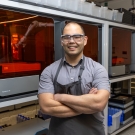
From sailing the San Francisco Bay to conducting undergraduate research and building industry connections, chemical engineering student Michael Pham has learned that adaptability, collaboration and a willingness to embrace uncertainty are essential to success.
From computer modeling to welding, Steel Bridge at UC Davis gives undergraduates the opportunity to apply engineering concepts beyond the classroom. The club's focus is an annual competition where students across the country construct a steel bridge within a time limit.
Following successful brain tumor surgery at UC Davis Medical Center, Robert Kobara knew he wanted to become a biomedical engineer. Now, nearly two decades later, he returns to UC Davis as a development engineer and graduate-level instructor for students in the medical device development program.
Who says handheld games have to fit in your hands? UC Davis electrical engineering alum Nick Alvarez co-created a 9-foot-tall, fully playable Game Boy Color that gives Pokémon and Donkey Kong room to stretch — and requires a U-Haul to transport.
UC Davis engineers are working across disciplines to develop AI-based technologies that aim to provide a reliable method for early detection of Alzheimer’s disease, expand care and support options for survivors of sexual assault and improve outcomes for patients expecting corneal transplants.
Fourth-year computer engineering student Hamza Hafeez shares how speedcubing shaped his UC Davis experience, from finding friends to leading the Davis Cube Club to growing through engineering research.
UC Davis Professor Cristina Davis and her lab are developing portable sensors to detect chemical signals exchanged by fungi and plants. Their work is part of a $7.5 million collaboration exploring how underground fungal networks respond to their environment.
With support from alum Jannie Wu and the Wu Family Foundation, COFFEE at UC Davis helps women in electrical and computer engineering build community, develop leadership skills and introduce younger students to engineering through workshops that blend circuits, creativity and hands-on learning.
Distinguished Professor Zhi Ding will lead the UC Davis Department of Electrical and Computer Engineering as its new chair, effective Jan. 1, 2027. “At this transformative moment when AI is revolutionizing education and society, it is a profound privilege to serve as chair,” he said.
UC Davis engineers are developing noninvasive fetal monitoring technology that uses near-infrared light and machine learning to estimate fetal blood pH, with the goal of giving clinicians better information in the delivery room.