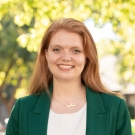
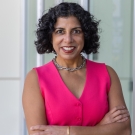
College of Engineering Celebrates Outstanding Faculty for Teaching, Research
The College of Engineering recognizes faculty member excellence in research and teaching each year with Outstanding Faculty Awards. Departments nominate faculty members, who are selected by the college’s Faculty Awards Committee to receive accolades.
The three research awards celebrate junior, mid-career and senior faculty members. The teaching award honors a professor who has demonstrated exceptional commitment to student success.
The four faculty members selected to receive Outstanding Faculty Awards will be formally honored at the College of Engineering Awards Celebration on June 1, 2026.

Outstanding Faculty Teaching Award
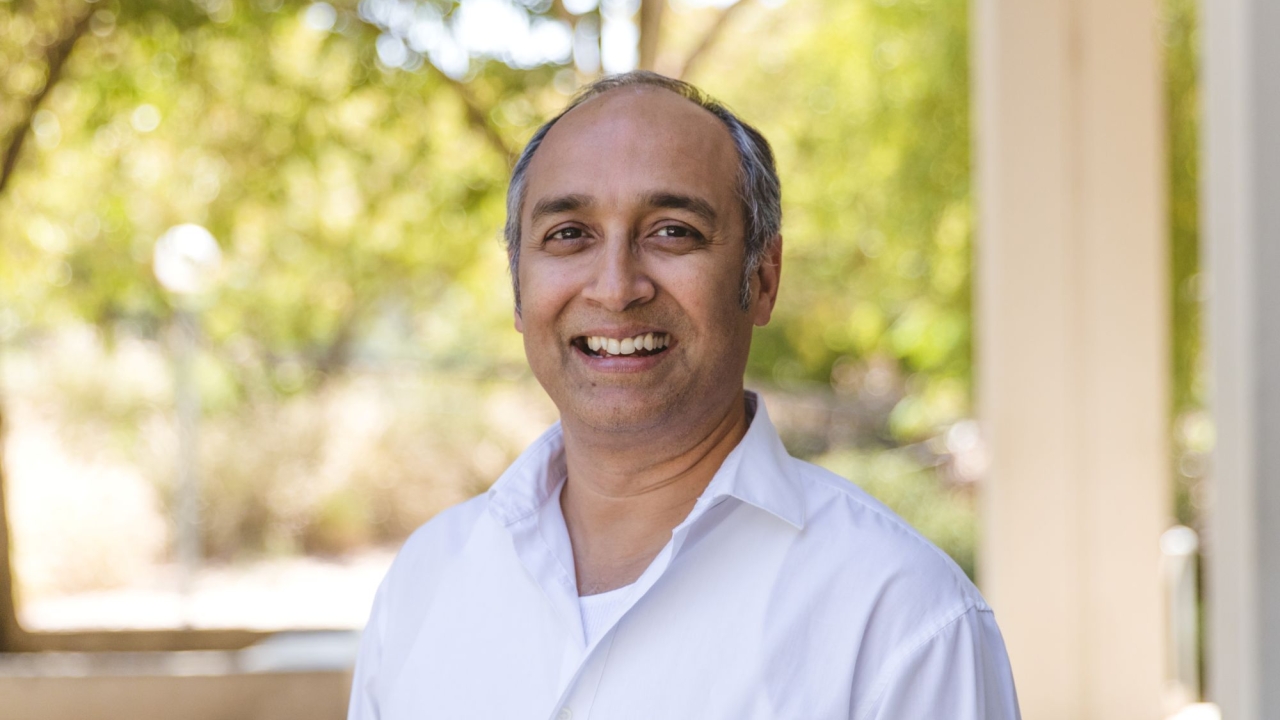
Harishankar Manikantan, Chemical Engineering
When Harishankar Manikantan saw issues with how students were learning coding in his “Chemical Engineering Problem Solving” class (a required course for all chemical engineering undergraduates), he rewrote the textbook. Literally.
“Numerical Methods for Engineering” is an open-source, interactive digital textbook for the class, in which Manikantan emphasizes computational literacy as a central component for solving chemical engineering problems. As part of the course redesign, Manikantan shifted from MATLAB to Python, the industry-standard programming language — a shift he integrated across the entire department. Manikantan is currently working with UC Davis Undergraduate Education and Continuing and Professional Education on a version of the curriculum that transfer students can take while at community college or in the summer to set them up for success.
Manikantan’s students praise his ability to convey complex concepts and his willingness to answer questions and meet with students outside of class. His instructor evaluations are consistently excellent.
Before joining UC Davis in 2019, Manikantan earned his Ph.D. in applied mechanics from UC San Diego, his Master of Science degree in theoretical and applied mechanics from the University of Illinois at Urbana-Champaign, and his Bachelor of Technology in mechanical engineering from the National Institute of Technology Karnataka in India.
Outstanding Junior Faculty Award
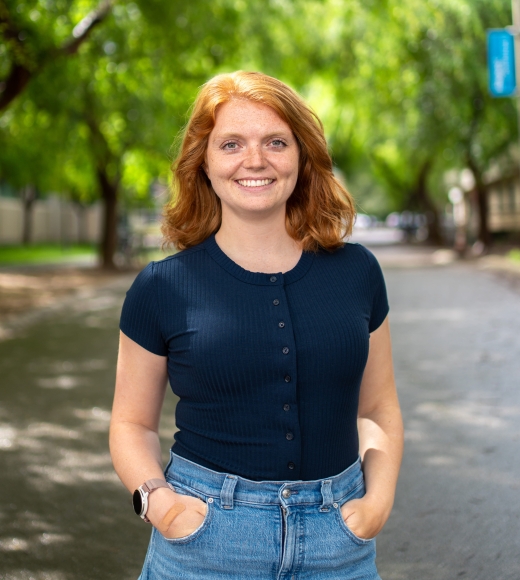
Christina Harvey, Mechanical and Aerospace Engineering
In her initial four years at UC Davis, Christina Harvey has soared.
As the lead of the Biologically Informed Research and Design, or BIRD, lab, Harvey investigates the functional principles of bird flight to deepen our understanding of animal locomotion and inspire the design of future uncrewed aerial vehicles.
To fully realize her research goals, Harvey has established the Center for Animal Locomotion and Innovation, or CALI, in collaboration with the California Raptor Center at the School of Veterinary Medicine, funded by a U.S. Army Combat Capability Development Command Army Research Office grant. The facility features state-of-the-art motion capture and photogrammetry technologies to image birds in flight, generating data for wind tunnel and related experiments and simulations.
Harvey’s commitment to furthering the field of aerospace extends beyond her research. In 2025, she co-led the Northern California Aerospace Symposium, welcoming more than 150 scholars and industry leaders to UC Davis to discuss the future of aerospace. She also devised the graduate course, “Advanced Aircraft Design,” which incorporates NASA-developed and industry-relevant tools.
Harvey is a 2023 Packard Fellow and a 2021 Earhart Fellow. She earned her Ph.D. in aerospace engineering from the University of Michigan, her Master of Science in zoology from the University of British Columbia, and her Bachelor of Engineering in mechanical engineering from McGill University.

Outstanding Mid-Career Faculty Award
Marina Leite, Materials Science and Engineering
At the intersection of energy, photonics and AI, Marina Leite consistently breaks new ground in her research.
Leite was among the first to apply machine learning to predict the stability and optical properties of perovskite solar cells, and has helped establish automated, high-throughput experimentation as a viable model for materials discovery. In the burgeoning field of transient photonics, she has demonstrated that magnesium and magnesium oxide can be used to build functional devices that dissolve in water, opening the door to environmentally friendly optical devices. She has also launched a new research thrust to advance understanding of materials’ optical properties at extreme temperatures.
Leite’s prolific research career has resulted in over 70 peer-reviewed papers in high-impact journals, such as Nature Energy and Advanced Materials, with over 4,400 citations, and over 200 invited talks at conferences and research institutions.
This year, she received the IEEE Photonics Society Lectureship Award. She was elected as a Fellow of SPIE and Optica in 2025 and was named a UC Davis Chancellor’s Fellow in 2023. As proof of her mentorship, her students have received 97 awards and honors thus far.
Leite completed her education in Brazil, earning her Bachelor of Science in chemistry at the Federal University of Pernambuco, and her Master of Science and Ph.D. in physics from Campinas State University.

Outstanding Senior Career Faculty Award
Raissa D’Souza, Computer Science and Mechanical and Aerospace Engineering
Since joining UC Davis in 2005, Raissa D’Souza’s foundational research has helped create the interdisciplinary field of network science and changed the game of complex systems.
Her 2007 cover story in the Proceedings of the National Academy of Sciences revealed the origins of network structure in optimization. Her 2009 Science publication reshaped how scientists understand connectivity in complex systems. Her recent 2023 Nature Reviews Physics perspective provides a roadmap for control of interdependent complex networks.
She has over 100 peer-reviewed publications that have earned numerous awards, including an ACM Test-of-Time award in 2018 and the Best Paper Award from Risk Analysis in 2020.
D’Souza was elected a Fellow of the American Physical Society in 2016 and of the American Association for the Advancement of Science in 2024. She was the second president of the Network Science Society, serving from 2015-18; in 2019, she was awarded their inaugural Euler Award and elected a Fellow of the society; and she received the Outstanding Service Award in 2022.
D’Souza earned her Bachelor of Science degree in physics from the University of Illinois Urbana-Champaign and her Ph.D. in physics from the Massachusetts Institute of Technology. She received the Outstanding Mid-Career Faculty Award in 2017 and is currently the Associate Dean of Research for the College of Engineering and acting director of the college’s AI Center in Engineering.